
How to Choose an Adjustable Bed Frame: Practical Guide for 2026
Learn how to choose an adjustable bed frame factors for November 2026, from steel gauge and center support to box spring requirements and headboard bracket fit.
 By Erica Puisis
Updated November 6, 2026

Upgrading a bedroom foundation often begins with the search for versatile support that can adapt to changing mattress sizes over time. When evaluating how to choose an adjustable bed frame, you need to understand whether your setup requires a modular width-adjusting metal framework or a powered articulating foundation. Solid steel construction, dedicated center support rails, and strategically positioned vertical legs form the backbone of a dependable sleep system that keeps your mattress level and quiet. Just as you might select an ergonomic office chair with adjustable back support to maintain healthy daytime posture, pairing your bed with the proper foundation prevents middle sagging and structural fatigue.
Modular metal frames offer unique flexibility by converting between standard sizing formats like Twin, Full, and Queen without forcing you to purchase a new foundation whenever you upgrade your mattress. However, securing these frames requires paying close attention to steel gauge thickness, box spring requirements, floor-to-rail clearance, and compatible headboard extension brackets. Many homeowners run into issues when their existing headboard mounting holes fail to align with standard frame brackets, making slotted multi-fit hardware essential. Understanding these mechanical details ensures that your bed frame remains sturdy, squeak-free, and capable of supporting your sleeping setup for years to come.
| Award | Product | HOF Score About HOF ScoreThe HOF Score is our own rating from 0 to 10, based on performance, design and build, ease of use, and value. It reflects independent research and is never influenced by manufacturers, retailers, or affiliate commissions. Learn more › | |
|---|---|---|---|
| Best Overall |
 Headboard Brackets for Metal Bed Frame Adjustable |
8.9/10 | Buy |
| Best Value |
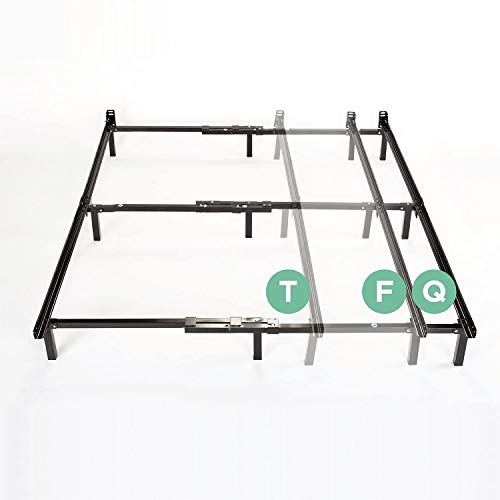 ZINUS Compack Metal Adjustable Bed Frame / 7 Inch |
8.4/10 | Buy |
Key Factors in Selecting an Adjustable Bed Frame Foundation
Evaluating how to choose an adjustable bed frame requires understanding how mechanical adjustability supports your specific mattress setup. Shoppers often encounter two distinct categories: modular steel frames that adjust in size to accommodate different mattress dimensions, and motorized bases that articulate the head and foot. If you need a modular metal frame, your primary focus should be on structural rigidity, center beam reinforcement, and hardware compatibility. Taking the time to evaluate these core specifications guarantees that your foundation will support your sleep system reliably.
Distinguishing Width-Adjustable Frames from Motorized Articulating Bases
The phrase adjustable bed frame commonly creates confusion because it refers to two completely different products. Motorized power foundations feature electric motors, remotes, and segmented decks designed to elevate the head and legs for ergonomic relief. In contrast, size-adjustable metal frames utilize sliding steel channels and locking pins to adapt to various mattress widths, such as shifting from Twin to Queen. Clarifying this distinction early in your shopping journey prevents ordering the wrong foundation for your bedroom.
A width-adjustable metal frame provides exceptional utility for guest rooms and rental properties where mattress sizes may change over time. Models like the universal Zinus Compack frame convert from Twin to Queen or Full to King, eliminating the need to buy a new base when upgrading your mattress. These frames rely on interlocking cross arms and rigid center beams that lock into place with heavy-duty pins or wedge locks. This adaptable design makes them a practical choice for households that value future flexibility.
While motorized power bases require specialized flexible mattresses and dedicated electrical outlets, mechanical size-adjustable frames focus on heavy-duty perimeter support. They do not elevate your mattress, but they provide the stable rectangular footprint required to hold standard sleep setups. Because they have no moving electrical parts or motors to maintain, quality metal frames offer exceptional longevity at an accessible price point. Identifying whether you want adjustable sleeping positions or adaptable frame sizing determines the right path forward.
Structural Steel Gauge and Center Support Architecture
Mattress longevity depends heavily on the strength of the steel used in your bed frame. Steel gauge measurements operate on an inverse scale, meaning a lower numerical gauge indicates thicker, stronger metal that resists bending under load. Heavy-duty components, such as the 9-gauge and 14-gauge steel brackets in the Sprthrd extension kit, provide the rigid structural integrity needed to anchor heavy headboards. Frames built with thin sheet metal often flex under dynamic sleeper movement, leading to sagging and joint failure.
Center support rails are an absolute necessity for any bed wider than a standard Twin. When sleepers rest on Full, Queen, or King mattresses, the middle of the frame absorbs the greatest concentration of combined body and mattress weight. High-quality frames feature a dedicated longitudinal center beam equipped with vertical support legs that rest firmly against the floor. Without this central reinforcement, the cross rails will bow downward over time, resulting in an uncomfortable middle dip that strains your spine.
The number and design of vertical support legs also dictate overall frame stability. Basic frames often offer only four corner legs, which leaves the center perimeter vulnerable to deflection. Superior adjustable frames incorporate multiple legs along the side rails and center beam, distributing weight across six to nine floor contact points. These legs should be engineered from solid steel and fitted with wide glides to protect hardwood and carpet surfaces.
Differentiating between static weight capacity and dynamic load is equally vital when evaluating frame strength. Static load refers to stationary weight, while dynamic load accounts for kinetic force exerted when people sit down or turn over. Choosing a frame with reinforced steel joints, heavy center beams, and robust corner gussets ensures the structure handles daily dynamic movement without warping. Investing in structural steel prevents premature mattress wear and keeps your sleep foundation completely level.
Foundation Compatibility and Box Spring Requirements
One of the most critical considerations when selecting a modular metal bed frame is foundation compatibility. Traditional metal adjustable bed frames are designed as open perimeter structures rather than solid platform decks. Because they feature only a steel perimeter and center beam without closely spaced horizontal slats, a box spring or rigid foundation is strictly required to support your mattress. Placing a mattress directly onto an open steel frame allows the mattress core to sink between the rails, ruining the internal structure.
Modern memory foam, latex, and hybrid mattresses are particularly sensitive to foundation support. Mattress manufacturers generally mandate that foam and hybrid cores rest on either a traditional box spring, a low-profile foundation, or a platform deck with slat gaps under three to four inches. If you place a foam mattress directly onto an open metal frame without a foundation, the localized pressure will deform the foam and void your manufacturer warranty. Always verify whether the frame you choose functions as a standalone platform or requires a separate foundation.
Calculating total bed height is another practical factor tied to foundation requirements. A standard 7-inch metal frame combined with a standard 9-inch box spring creates a 16-inch base before you add your mattress. Pairing this setup with a thick 12-inch luxury mattress results in a sleep surface height of twenty-eight inches from the floor. If you prefer a lower profile that allows effortless entry and exit, you can pair your adjustable metal frame with a low-profile 4-inch or 5-inch box spring instead.
Headboard and Footboard Bracket Alignment and Attachment
Many buyers purchase an adjustable metal bed frame only to discover that their existing decorative headboard does not mount cleanly to the frame. Most standard metal frames come with basic mounting tabs or no brackets at all, leaving you with an unattached headboard that leans against the wall. Understanding bracket compatibility and extension hardware is vital if you plan to attach a freestanding headboard or footboard to your foundation.
Adjustable headboard brackets, like the heavy-duty Sprthrd extension kit, solve this common mismatch by offering customized slotted channels. These multiple-slot designs allow you to adjust both the width and vertical height of the mounting plate, accommodating varying hole spacing on wooden or upholstered headboards. Because manufacturing standards for headboards differ widely across brands, having multiple adjustment slots ensures you can center and secure your headboard without drilling new holes into finished furniture.
Connection types also vary between bolt-on and hook-on configurations. Bolt-on brackets utilize heavy machine bolts, washers, and nuts that clamp through pre-drilled holes in the headboard legs, creating a rigid mechanical bond. Hook-on headboards feature vertical pins or slots that drop into matching frame brackets. If your bed frame only supports bolt-on connections but your footboard requires hook-on slots, you will need specialized adapter plates to achieve a secure connection.
Proper bracket installation prevents persistent headboard wobbling that can scuff bedroom walls or cause distracting creaks whenever you shift position. High-strength steel brackets with an electrophoresis-coated matte black finish resist rust, corrosion, and bending under lateral pressure. Ensuring that your bracket kit includes all necessary bolts, locking nuts, and wrenches saves you extra trips to the hardware store and guarantees a tight, rattle-free installation.
Floor Clearance, Under-Bed Storage, and Room Navigation
Bedroom organization frequently hinges on the amount of functional space available beneath the sleeping surface. The Zinus Compack frame provides seven inches of vertical clearance from the floor to the bottom of the steel side rails. While seven inches is too compact for extra-large bins, it offers ample space for low-profile storage containers, shoe organizers, and seasonal linen bags. This clearance also allows slim robot vacuums to navigate beneath the bed and keep dust under control.
Room layout standards require balancing frame footprint with comfortable walking pathways. Interior design guidelines recommend maintaining at least twenty-four to thirty inches of walking perimeter clearance between your bed rails and surrounding walls or furniture. In compact living quarters, optimizing walkway clearance is just as essential as planning compact furniture arrangements for small spaces, ensuring that bedside drawers, closet doors, and pathways remain unblocked. Choosing a frame that matches your mattress footprint without unnecessary protruding corners prevents painful stubbed toes in tight bedrooms.
Doorway and stairwell navigation during move-in is another area where modular metal frames excel over bulky wood platforms. Flat-pack metal bed frames arrive in compact cartons that easily maneuver through tight hallways, narrow staircases, and standard doorways. This compact shipping profile dramatically reduces delivery friction for apartment dwellers and renters who move frequently. Once inside the room, the frame unpacks quickly without overwhelming your available floor space during assembly.
Assembly Logistics, Joint Rigidity, and Squeak Elimination
Assembly frustration is a common concern when purchasing bedroom furniture, but modern metal frames have streamlined this process significantly. The Zinus Compack bed frame features an intuitive folding structure with recessed legs and pre-aligned pins that allow setup in under thirty minutes. Eliminating complex hardware bags and confusing multi-step joinery makes single-person assembly completely feasible. Clear instructions and included assembly tools ensure that even novice builders can establish a stable foundation quickly.
Persistent frame squeaking is one of the most frustrating sleep disruptions, typically caused by metal-on-metal friction at loose joint connections. When frame bolts lose tension, sleeper movement causes the steel brackets to rub against each other, generating high-pitched creaks. To prevent squeaking, ensure that all connecting bolts are tightened securely during initial assembly, and inspect fastener tightness after the first few weeks of use. Adding nylon washers or friction-reducing rubber pads between metal contact points provides an effective acoustic barrier that keeps the frame silent.
Material finishes play a significant protective role in long-term frame durability. High-grade metal frames and extension brackets utilize electrophoresis coatings or electrostatic powder finishes to seal the steel against moisture and oxidation. Just as specialized coatings protect weather-resistant metal furniture frames from environmental wear, rust-resistant matte black coatings prevent indoor humidity from corroding structural bed joints. A smooth, durable finish also prevents rough metal edges from snagging bedding or scratching your hands during sheet changes.
Protecting your bedroom flooring is the final step in ensuring lasting frame performance. Metal bed legs must be equipped with smooth, durable glides or heavy-duty plastic caps that distribute downward pressure evenly. On polished hardwood, laminate, or luxury vinyl plank floors, adding adhesive felt pads underneath the leg glides prevents gouging and scuffs when the bed shifts. On high-pile carpet, wide base glides prevent deep indentations that can destabilize the frame and tilt your mattress out of level.
Practical Pre-Purchase Checklist for Modular Bed Frames
Before purchasing your new adjustable metal foundation, run through a quick verification checklist to guarantee a smooth setup. Confirm that your mattress dimensions match the intended sizing conversion of the frame, whether you are staging a Twin, Full, Queen, or King mattress. Verify that you have an appropriate box spring ready, as open steel frames cannot support bare mattresses on their own. Check your headboard mounting requirements and ensure you have slotted extension brackets if you plan to secure a decorative headboard.
Selecting the right modular bed frame ultimately comes down to matching durable structural engineering with your long-term bedroom plans. Prioritizing solid steel construction, multiple vertical support legs, and reliable center beam architecture provides the steadfast stability your sleep system demands. By considering foundation requirements, bracket flexibility, and floor-to-rail clearance from the outset, you can create a quiet, comfortable, and versatile sleeping environment that serves your home for years to come.
About the author
Erica Puisis is a freelance writer and product reviewer specializing in home and lifestyle products. Her work includes researching standing desks, desk converters, and practical equipment for modern living spaces. She focuses on explaining product features, comparing available options, and identifying considerations that influence everyday usability. Her experience researching and testing consumer products helps readers understand the differences between competing designs and make purchasing decisions based on their individual needs.