
How Does an Ergonomic Chair Help: Practical Guide for 2026
Understand how does an ergonomic chair help posture, relieve spinal pressure, and support all-day comfort at your desk in November 2026.
 By Anthony Spadafora
Updated October 17, 2026

Midday spinal stiffness and persistent lower back fatigue often signal that a standard office seat is failing your body during long work hours. Sitting on a rigid dining chair or an unsupportive desk seat collapses your natural lumbar curve, which forces spinal discs and surrounding muscles to carry uneven loads. Exploring how does an ergonomic chair help reveals how purpose-built seating counters fatigue by actively supporting the spine’s natural inward curve. Purpose-engineered office seating distributes body weight evenly across the pelvis, keeps joints resting at neutral angles, and reduces physical strain throughout demanding shifts. A supportive chair, especially when paired with an adjustable office chair for back relief, stabilizes your body so you can stay productive without constant soreness.
Proper ergonomic seating adapts to individual body dimensions rather than forcing the user to conform to a rigid, static frame. Features like multi-axis armrests, independent lumbar depth calibration, and synchro-tilt recline mechanisms allow subtle posture shifts while maintaining full spinal contact. This responsive structure prevents dangerous sacral sitting and removes popliteal pressure behind the knees, ensuring uninterrupted blood circulation down through your legs. Balancing proper seated posture alongside the ergonomic benefits of standing desks creates an active workstation habit that keeps joints loose and muscles refreshed. Upgrading your seating is fundamentally about preserving physical energy and long-term musculoskeletal wellness.
| Award | Product | HOF Score About HOF ScoreThe HOF Score is our own rating from 0 to 10, based on performance, design and build, ease of use, and value. It reflects independent research and is never influenced by manufacturers, retailers, or affiliate commissions. Learn more › | |
|---|---|---|---|
| Best Overall |
 HUANUO Ergonomic Office Chair with 3D Armrests |
9.2/10 | Buy |
| Best Budget |
 Cross Legged Office Chair |
9.1/10 | Buy |
| Best Value |
 NYPOT Ergonomic Kneeling Chair with Adjustable |
9.1/10 | Buy |
| Best Premium |
 CLOUVOU Ergonomic Office Chair Comfy [#1 in reviews] |
8.8/10 | Buy |
 GABRYLLY Ergonomic Office Chair with Footrest |
8.8/10 | Buy | |
 MALOL Ergonomic Mesh Office Chair with Footrest |
8.6/10 | Buy | |
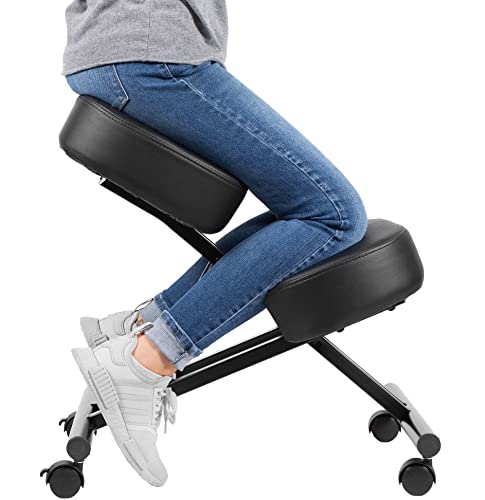 DRAGONN by VIVO Black Ergonomic Kneeling Chair |
8.3/10 | Buy | |
 CloudBliss Lumbar Support Pillow |
8.1/10 | Buy | |
 Office Chair, Ergonomic Desk Chairs 330LBS |
8.0/10 | Buy | |
 GABRYLLY Ergonomic Office Chair |
8.0/10 | Buy |
Biomechanical Principles and Health Benefits of Ergonomic Office Seating
An ergonomic chair works by actively matching the natural biomechanical contours of your body, rather than forcing your musculoskeletal frame to support its own weight in a rigid posture. Standard office chairs lack adjustability, causing users to slump forward, compress spinal discs, and restrict lower limb circulation over long shifts. Purpose-built ergonomic seating counters these physical strains through adjustable lumbar supports, flexible tilt mechanisms, contoured seat pans, and multi-directional armrests. These integrated components distribute upper-body mass evenly across the seat and backrest, stabilizing the spine and preventing chronic muscle exhaustion throughout extended workdays.
Restoring Natural Spinal Curvature and Relieving Lumbar Disc Pressure
The human spine possesses a natural inward curve in the lower back, scientifically referred to as lumbar lordosis. Sitting on an unsupportive seat causes the pelvis to tilt backward into a posterior pelvic tilt, flattening this natural curve into a hunched, C-shaped posture. This slouched position dramatically increases hydrostatic pressure within the intervertebral discs, particularly between the L4, L5, and S1 vertebrae. Over time, sustained disc pressure can trigger chronic lower back ache, muscle spasms, and severe disc wear.
Ergonomic chairs resolve this strain by providing targeted, adjustable lumbar support that fills the lumbar curve and gently pushes the lower spine forward into neutral alignment. Advanced task chairs, such as the GABRYLLY ergonomic chair or HUANUO office seating, incorporate height-adjustable and depth-adjustable lumbar cushions that conform to different torso heights. Physically stabilizing the lumbosacral region allows postural muscles to relax rather than constantly contracting to hold the torso upright. This targeted reinforcement prevents the mid-afternoon postural collapse that leaves desk workers feeling stiff and sore.
Workers using non-adjustable furniture often compensate for missing spinal support by adding dedicated accessories like the CloudBliss lumbar support pillow. An external memory foam cushion helps fill the gap between the backrest and the lower spine, repositioning the pelvis into a healthier angle. Built-in dynamic lumbar mechanisms remain preferable because they adapt smoothly as you recline or shift positions. Maintaining consistent contact between the backrest and your lower back ensures that your body weight remains supported throughout the day.
Alleviating Hip Pressure and Promoting Lower Extremity Circulation
Traditional flat desk chairs concentrate user body weight directly onto the ischial tuberosities, commonly known as the sit bones. When body weight concentrates over a narrow surface area, soft tissues in the buttocks experience localized pressure, causing numbness and soreness after several hours. Contoured seat cushions distribute this load over a wider contact area, relieving acute pressure points under the pelvis. A wider seat pan provides a balanced foundation that prevents the hips from feeling constricted during all-day desk work.
Another major vascular issue caused by standard seating is popliteal pressure, which occurs when the front edge of a seat pan presses directly against the soft tissue behind the knees. This constriction compresses the popliteal vein and the sciatic nerve, leading to tingling feet, swelling in the calves, and sluggish venous circulation. Ergonomic task seating counters this risk by incorporating a gentle waterfall front seat edge that curves downward away from the thighs. This downward contour preserves capillary blood flow down the legs and eliminates direct contact with sensitive nerve pathways.
Proper seat depth plays an equally critical role in protecting lower limb circulation during sedentary tasks. Quality ergonomic chairs allow users to adjust the seat pan forward or backward to maintain a vital two-finger to three-finger clearance gap behind the knees. When the seat pan is too deep, the backrest pushes the user forward, eliminating lumbar support; when it is too shallow, the thighs lack adequate surface support. Calibrating this distance ensures that your thighs remain properly supported without impinging on the circulatory channels in the lower extremities.
Reducing Shoulder Impingement and Cervical Spine Tension
Unsupported arms place a continuous mechanical load on the trapezius, levator scapulae, and rhomboid muscles across the upper back and neck. When desk workers type without resting their forearms on stable armrests, the shoulder girdle must contract constantly to hold the weight of the arms in space. This sustained isometric tension quickly radiates up into the neck, resulting in tension headaches, tight shoulder knots, and cervical joint stiffness. Ergonomic seating addresses this issue through adjustable 3D armrests and 4D armrests that move in height, width, depth, and pivot angle.
Adjusting the armrests so they support the forearms at an exact ninety-degree elbow angle allows the shoulder blades to drop into a natural, relaxed position. Models like the Synorla ergonomic desk chair also offer ninety-degree flip-up armrests, which allow users to slide their chair close to the desk surface without bumping into the frame. Positioning your body close to the working area prevents forward reaching, which is the primary cause of rounded shoulders. Keeping your wrists and forearms aligned parallel to the floor also minimizes wrist extension, reducing the risk of nerve irritation.
Cervical spine support becomes essential when working through extensive reading, conference calls, or reclining review sessions. Dedicated 2D and 3D headrests, found on high-back models like the MALOL mesh office chair, cradle the suboccipital curve at the base of the skull. A properly aligned headrest prevents the head from drifting forward toward the computer display, a condition frequently called forward head posture. By supporting the weight of the human head, an ergonomic headrest takes considerable strain off the delicate cervical vertebrae.
Dynamic Recline Kinematics and Intervertebral Disc Hydration
Rigid, stationary sitting is inherently stressful for human physiology because spinal discs lack an active vascular blood supply and depend on movement to absorb nutrients. When you remain locked in a static, upright position for hours, fluid is squeezed out of the intervertebral discs, accelerating disc compression and fatigue. Dynamic synchro-tilt mechanisms allow the backrest and the seat pan to recline in synchronization, usually at an ergonomic two-to-one ratio. This mechanical ratio ensures that when the backrest tilts backward by twenty degrees, the seat cushion rises by approximately ten degrees.
Synchronized reclining opens the hip-to-torso angle beyond ninety degrees, which significantly reduces the mechanical load on the lower lumbar spine. At a relaxed recline angle of one hundred to one hundred ten degrees, body weight shifts partially from the seat cushion to the backrest, lowering internal disc pressure. Simultaneously, gentle movement pumps vital nutrients and fluid into spinal cartilage, maintaining disc hydration through passive daily motion. Ergonomic chairs like the CLOUVOU office chair and GABRYLLY recliners let you lock the recline at multiple intervals or adjust the tilt tension to match your personal body mass.
Calibrating the tilt tension knob beneath the seat pan ensures that the backrest moves in harmony with your natural body weight. When tension is set too loose, the chair drops backward abruptly; when it is set too tight, the backrest forces you into a rigid, upright posture. Fine-tuning this balance provides smooth, weight-activated resistance that supports micro-movements throughout your working hours. Gentle posture shifts prevent joint stiffness, improve venous circulation, and keep core stabilizing muscles subtly engaged without inducing physical fatigue.
Active Sitting and Alternative Ergonomic Postures
Beyond traditional high-back task seating, alternative designs such as ergonomic kneeling chairs offer unique postural benefits by shifting how body weight is distributed. Designs like the NYPOT kneeling chair and the DRAGONN by VIVO kneeling stool feature an angled seat paired with cushioned shin rests. Pitching the pelvis forward at an angle of twenty to thirty degrees encourages a natural upright spinal alignment without needing a tall backrest. This forward tilt naturally restores lumbar lordosis, engaging deep core stabilizing muscles and preventing the posterior pelvic slump common to standard desk seating.
A frequent misconception regarding kneeling chairs is that the user’s entire body weight rests onto the knees and shins. In reality, a properly configured kneeling chair distributes most body weight onto the buttocks, with only a smaller fraction transferring to the shins. Models featuring curved wooden rockers provide subtle rocking motions that keep the hips mobile and stimulate joint lubrication. However, new users must acclimate gradually to kneeling chairs over one to two weeks, as the shin muscles and unfamiliar postural stabilizers require time to build endurance.
Similarly, multifunctional designs like the HOMRELEXA cross-legged office chair cater to individuals who struggle with static sitting postures, including neurodivergent workers and active thinkers. With extra-wide cushions and flexible lower heights, cross-legged seating allows users to switch between standard sitting, criss-cross meditation postures, and kneeling positions. Alternating physical postures during long workdays prevents blood pooling, reduces repetitive hip strain, and accommodates diverse physical needs. Providing options for dynamic seating variety helps maintain physical comfort and mental focus across demanding creative or administrative projects.
Step-by-Step Calibration Sequence for Proper Neutral Alignment
Owning an adjustable ergonomic chair does not help your posture if the chair is not calibrated systematically to your specific physical dimensions. Begin the calibration process by setting the pneumatic seat height so your feet rest completely flat on the floor with your knees bent at a ninety-degree to one-hundred-degree angle. Your thighs should rest horizontal or slope slightly downward to keep the hip joints open and relaxed. For shorter individuals whose feet dangle, pairing your chair with a dedicated footrest or implementing workstation adjustments for shorter users ensures full lower-body stability without cutting off circulation under the thighs.
Next, adjust the seat pan depth slider until there is a clear two-inch to three-inch gap between the front cushion edge and the back of your knees. Once the seat pan depth is locked, position the vertical height of the lumbar support so the convex pad rests squarely in the inward curve of your lower back, roughly across the L1 to L5 vertebrae. The lumbar cushion should provide gentle, continuous support without aggressively pushing your stomach forward or digging uncomfortably into your sacrum. Lean your torso fully back against the mesh or fabric backrest so the chair bears your upper-body mass.
Finally, calibrate the armrests and desk interface so your shoulders remain completely relaxed without shrugging upward or dropping down. Adjust the armrest height until your forearms rest naturally parallel to your work surface, matching the height of your keyboard and mouse. Integrating your seating adjustments alongside a versatile height-adjustable standing desk setup allows you to maintain consistent elbow and forearm alignment whether sitting or standing. Completing these systematic adjustments transforms an ordinary chair into a customized orthopedic tool tailored precisely to your musculoskeletal needs.
Evaluating Seating Materials: High-Density Foam Versus Breathable Suspension Mesh
The materials used to construct an ergonomic chair significantly influence thermal regulation, pressure point relief, and long-term durability. High-tensile breathable mesh backrests, found on models like the GABRYLLY mesh chair and HUANUO office seating, provide continuous air circulation across the back. In warm home office environments, open-weave mesh dissipates body heat and perspiration, preventing the sticky, clammy discomfort associated with non-porous bonded leather or heavy vinyl upholstery. Mesh also yields dynamically to the contours of your spine, offering responsive resistance without rigid pressure spots.
While mesh backrests excel at ventilation, seat pan construction involves a distinct functional tradeoff between all-mesh suspension seats and high-density foam cushions. High-density cold-cure or molded foam seats, such as the three-inch padded cushions on the Synorla and HUANUO chairs, provide uniform structural support that resists bottoming out over years of heavy use. High-density foam excels at absorbing heavy loads, cushioning the pelvic bones and preventing pressure from transferring directly to the tailbone. Low-grade foam, by contrast, degrades rapidly, losing its rebound elasticity and leaving users sitting directly against the hard baseplate.
All-mesh seat pans eliminate foam breakdown entirely and offer unmatched cooling, but they require a rigid perimeter frame to maintain mesh tension. For users with broader frames or those who like to shift positions, these hard perimeter edges can press uncomfortably against the outer thighs. Upholstered high-density foam cushions with waterfall front edges generally offer a more forgiving surface for users who prioritize plush pelvic cushioning over maximum airflow. Evaluating your personal tendencies regarding body temperature, body shape, and sitting duration will help you choose the ideal cushion composition for your daily desk tasks.
Long-Term Musculoskeletal Health and Workspace Habit Integration
Investing in a well-engineered ergonomic chair delivers substantial physical returns by curbing repetitive strain injuries and minimizing chronic spine degeneration. By distributing upper-body mass, supporting the natural lumbar lordosis, and eliminating popliteal nerve compression, ergonomic seating preserves your physical endurance across intensive eight-hour workdays. Workers who transition from rigid conventional chairs routinely report significant reductions in neck stiffness, lower back soreness, and midday mental fatigue. When physical discomfort no longer distracts your attention, workplace productivity, mental clarity, and overall well-being improve dramatically.
Even the most advanced ergonomic office chair cannot replace the fundamental biological necessity of physical movement throughout the day. The healthiest desk setup combines calibrated ergonomic seating with frequent micro-breaks, dynamic posture shifts, and periodic intervals of standing. Take time every thirty to sixty minutes to stand, stretch your hip flexors, and reset your gaze to prevent visual and postural fatigue. Utilizing an ergonomic chair as an active posture partner within a balanced, dynamic workspace ensures lasting spinal health, physical comfort, and sustainable focus.
About the author
Anthony Spadafora is an experienced technology journalist and home office furniture reviewer specializing in ergonomic office chairs, standing desks, and workspace accessories. Having worked remotely since 2018, he brings extensive hands-on experience to evaluating furniture for modern home offices. His reviews explore comfort, adjustability, build quality, cable management, and practical workspace improvements, helping readers understand the features that matter when investing in a home office setup.