
How Tall Should a Changing Table Be? Ergonomic Height Guide for 2026
Learn %how tall should a changing table be% to prevent back strain and improve posture in October 2026 with practical ergonomic nursery guidelines.
 By Melanie Pinola
Updated September 30, 2026

Caring for an infant requires hundreds of diaper changes during the first year alone, making upright posture and ergonomic workstation design essential for daily physical comfort. Setting up a dedicated infant care station often raises the crucial question of %how tall should a changing table be% to prevent persistent lower back strain, neck stiffness, and shoulder fatigue. Most standard nursery furniture positions the primary changing surface between 34 and 40 inches from the floor, though parent height and personal body mechanics play a critical role in finding the ideal fit. Applying proven adjustable height standing surfaces logic helps parents evaluate how table elevation directly impacts spinal alignment during repetitive daily tasks.
A properly sized table allows caregivers to tend to their baby with relaxed shoulders, elbows bent at roughly a ninety-degree angle, and feet firmly planted. Selecting an improper surface height often forces taller caregivers to hunch uncomfortably or requires shorter parents to elevate their arms awkwardly, increasing physical fatigue and reducing safety control. Understanding the exact dimensional differences between fixed wooden dressers, multi-level adjustable metal frames, and wall-mounted stations ensures both adult comfort and infant security. By evaluating table profile heights alongside safety railings and contour pads, families can establish a supportive, organized changing station tailored to their specific living space.
| Award | Product | HOF Score About HOF ScoreThe HOF Score is our own rating from 0 to 10, based on performance, design and build, ease of use, and value. It reflects independent research and is never influenced by manufacturers, retailers, or affiliate commissions. Learn more › | |
|---|---|---|---|
| Best Budget |
 Baby Changing Table with Wheels |
9.1/10 | Buy |
 Delta Children Infant Changing Table with Pad |
8.4/10 | Buy | |
| Best Premium |
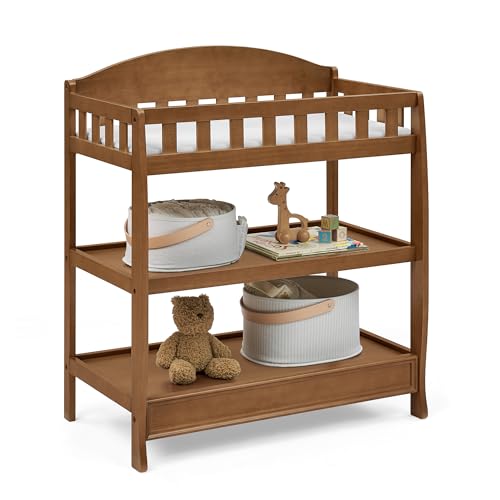 Delta Children Infant Changing Table with Pad |
8.4/10 | Buy |
| Best Value |
 Delta Children Scout Changing Table, Chestnut |
8.6/10 | Buy |
 VEVOR Baby Changing Table |
7.8/10 | Buy | |
 Tourpear Changing Table Dresse with 3 Drawers |
7.8/10 | Buy | |
| Best Overall |
 Saryocy Baby Changing Table with Storage |
9.2/10 | Buy |
 Alpine Wall Mounted Baby Changing Station |
8.3/10 | Buy |
Essential Dimensions and Ergonomic Guidelines for Infant Changing Tables
Finding the right changing table elevation directly influences how comfortably caregivers handle daily infant routines. A surface that matches caregiver proportions eliminates chronic spinal bending while providing stable, secure boundaries for an active infant. Exploring standard dimensions, individual body mechanics, and adjustable furniture designs makes it easier to select a setup that protects physical health across months of daily diaper changes.
The Standard Height Baseline for Nursery Changing Surfaces
Standard nursery changing tables traditionally sit between 34 and 36 inches above the finished floor. This dimensional window evolved to accommodate average adult standing heights, allowing most individuals between five feet three inches and five feet ten inches to attend to their child comfortably. Traditional wooden models frequently adhere strictly to these dimensions, offering consistent stability alongside built-in storage shelves. For example, classic dressers and dedicated tables like the Tourpear changing dresser present a working surface at 34.8 inches, while the Delta Children Scout changing table measures 34.7 inches high.
Some fixed wooden units extend slightly higher to provide extra relief for taller parents. Designs such as the Delta Children Infant changing table reach 39.25 inches in total height, positioning the top rails higher to accommodate thicker contour pads. When diapering an infant up to ten times each day, a difference of three or four inches significantly alters the load placed on lumbar vertebrae. Selecting a table within the 34 to 39 inch spectrum provides a reliable starting point for standard domestic nurseries.
Calculating Your Ideal Table Height Using the Elbow Rule
Determining individual table height requirements relies on the natural resting position of a caregiver’s forearms. An optimal standing work surface generally sits between two and four inches below the caregiver’s bent elbow when standing upright with relaxed shoulders. To calculate this measurement accurately, stand barefoot or in typical home footwear with your elbow bent at a ninety-degree angle. Measure the distance from the floor to the underside of the forearm, then subtract three inches to establish your target surface elevation.
Applying this ergonomic calculation prevents both cervical compression from looking down excessively and trapezius tension from raising the arms. In households where caregivers differ considerably in height, finding a single static height can present practical challenges. The taller parent typically experiences lumbar fatigue on lower tables, while the shorter parent must raise their forearms, compromising leverage and balance stability. Reviewing established standing height posture guidelines highlights how vertical alignment must balance torso angles with hand reach.
Fixed Wooden Changing Tables vs. Multi-Height Adjustable Frames
Modern nursery furniture splits primarily into traditional fixed wood furniture and portable adjustable height stations. Fixed wooden furniture, often built from New Zealand pine, poplar, or TSCA compliant engineered wood composites, offers long-term visual cohesion and substantial weight. These units maintain a permanent height between 34 and 39 inches, transitioning gracefully into regular bedroom dressers or hallway consoles after diapering years conclude. Their heavy wooden frames provide exceptional rigidity, eliminating wobble during active diaper changes.
In contrast, contemporary portable changing stations feature tubular steel or reinforced metal frames paired with waterproof Oxford fabric surfaces. Products like the Saryocy baby changing table provide four selectable height settings spanning from 43.30 to 49.21 inches. Similarly, portable models from VEVOR and Sanmico incorporate four-stage telescopic legs to elevate the changing platform specifically for taller caregivers. These elevated ranges allow adults over six feet tall to stand fully upright without rounding their upper back, reducing cumulative spinal compression.
How Changing Pad Thickness and Safety Guardrails Affect Usable Height
A table’s listed frame height does not always equal the actual working surface where the baby rests. Many wooden changing tables require a separate contour changing pad, typically measuring one to two inches in thickness. For instance, the Delta Children Scout accepts standard 32-inch by 16-inch by 1-inch pads, which raises the effective contact elevation by one full inch. Placing a thick, plush contour pad onto an already tall 39-inch table elevates the baby closer to 41 inches, altering forearm angles.
Surrounding guardrails also play an essential role in ergonomic reach and infant containment. Standard safety specifications mandate protective rails enclosing the perimeter, often extending three to four inches above the pad base. Caregivers must comfortably reach over these rails without resting their wrists on rigid wood corners. Smooth, rounded edges help prevent localized pressure points on forearms during longer dressing sessions. Factoring pad thickness into your total vertical calculation ensures the finished work surface aligns with your natural elbow height.
Wall-Mounted Station Clearance and Commercial ADA Height Standards
Wall-mounted fold-down changing stations present a distinct set of installation rules and dimensional standards. Because these horizontal platforms anchor directly into wall studs, parents and facility managers control the precise mounting height during installation. Units like the Alpine wall mounted baby changing station feature heavy-duty folding hinges and safety straps designed for compact bathrooms or dedicated utility areas. When folded flat against the wall, these stations preserve floor space while offering immediate accessibility when deployed.
Commercial installations governed by the Americans with Disabilities Act (ADA) require specific clearance tolerances to accommodate seated or standing users. ADA guidelines generally specify that the open horizontal changing surface must sit between 28 and 34 inches above the floor, with adequate knee clearance beneath the unit. For residential home installations, caregivers can disregard commercial ADA mandates and mount the station higher, aligning it directly with personal elbow measurements. Proper installation requires securing heavy-duty lag bolts directly into structural wall studs to support dynamic infant weights safely.
Storage Ergonomics and Safe Reach Zones
Table height directly influences how easily caregivers reach diapers, wipes, ointments, and spare clothing without turning away from the infant. The primary golden rule of infant diapering is maintaining at least one hand on the baby at all times to prevent accidental rolls or falls. When storage compartments sit too low, caregivers must bend awkwardly sideways while attempting to steady the child, straining core muscles and reducing balance. Ergonomically designed tables integrate storage immediately beneath or beside the changing tray to prevent extreme reaches.
Fixed wooden units like the Delta Children Infant table feature two fixed shelves positioned roughly ten to twelve inches apart, allowing clear sightlines to diaper caddies. Portable steel frames often include hanging side organizers, mesh baskets, and pull-out fabric drawers situated right at waist level. For example, Saryocy models provide side pouches and deep drawers that keep daily essentials visible without requiring caregivers to squat or hunch. Organizing high-frequency supplies within arm’s reach ensures smooth, distraction-free diaper changes that safeguard infant stability.
Floor Stability, Caster Locks, and Anti-Tip Wall Fasteners
Increasing the height of any table inevitably shifts its center of gravity upward, making structural stability paramount. Taller changing units must possess a broad base footprint to resist lateral racking forces when an infant wiggles or rolls. Metal-framed portable stations counteract tipping risks by using reinforced cross-bracing and wide stance legs that support up to 100 pounds. These portable designs frequently incorporate 360-degree swivel wheels, allowing parents to roll the station across hardwood, tile, or low-pile rugs.
Engaging wheel brake locks before placing a child on the table is an indispensable safety procedure. High-grade caster locks prevent the table from shifting away during sudden movements or active dressing routines. For taller wooden changing dressers, wall-anchoring anti-tip safety straps provide vital protection against accidental tipping as infants grow heavier and more mobile. Furniture units like the Tourpear changing dresser explicitly include wall-anchoring hardware to secure the solid frame firmly against structural wall framing.
Small-Space Layout Planning and Room Clearance
Nursery layouts frequently contend with limited square footage, requiring thoughtful perimeter clearance around changing surfaces. Standard interior planning recommendations suggest maintaining a minimum of 36 inches of clear walking pathway in front of the table. This perimeter clearance ensures caregivers can stand comfortably, maneuver diaper pails, and open storage drawers without feeling pinned against cribs or adjacent walls. Incorporating concepts from compact standing station designs helps parents optimize tight nursery corners without sacrificing ergonomic utility.
When floor space is exceptionally tight, foldable changing stations provide substantial spatial relief. Modern portable units from Sanmico and VEVOR feature one-click folding mechanisms that collapse the frame flat for closet or behind-the-door storage. This space-saving adaptability suits shared master bedrooms, urban apartments, and grandparents’ homes where a dedicated changing station cannot remain permanently expanded. Checking the folded profile dimensions ensures the frame slips effortlessly into narrow alcoves without blocking main room traffic.
Practical Setup Verification and Posture Adjustments
Validating your changing table height before your infant arrives helps avoid uncomfortable surprises during sleep-deprived postpartum weeks. Test the assembled table by standing directly in front of the pad with shoulders dropped and arms bent as if holding a newborn. If your wrists flex upward or your shoulders shrug, the surface is too high; if your spine curves forward to reach the pad, the surface is too low. Using a soft anti-fatigue mat beneath your feet can also cushion standing joints while subtly adjusting your working height by half an inch.
Caregivers can also fine-tune their physical approach by wearing supportive indoor shoes rather than walking barefoot on hard floors. If multiple caregivers share a fixed-height table, the shorter adult can utilize a wide, non-slip wooden step platform to elevate their stance safely. Meanwhile, taller caregivers using fixed lower tables should widen their foot stance slightly to lower their center of gravity without bending at the lumbar spine. Thoughtful ergonomic planning turns everyday infant care into a comfortable, sustainable routine that protects parental wellness.
About the author
Melanie Pinola is an experienced technology and productivity writer whose work includes researching home office equipment and ergonomic furniture. She has contributed to detailed office chair buying guides, examining the considerations involved in selecting comfortable and functional seating. Her writing focuses on practical technology, productivity, and the equipment people use in everyday working environments, helping readers make more informed purchasing decisions.