
How to Organise an L Shaped Desk: Practical Setup Guide for 2026
Learn how to organise an l shaped desk in November 2026 to optimize surface space, bridge corner seams, and create dedicated dual-zone workflows.
 By Arriana Vasquez
Updated November 6, 2026

Corner workstations provide expansive surface area, but an unstructured layout quickly turns that extra room into a clutter magnet. Learning how to organise an l shaped desk requires viewing the dual-desktop surface as two distinct functional environments connected by a central transition point. When planning your workstation geometry, choosing a functional home office desk layout that accommodates both active computer tasks and secondary projects protects your physical comfort. A well-structured arrangement eliminates awkward torso twisting, supports neutral neck alignment, and keeps everyday essentials within arm’s reach.
Many professionals struggle with the 90-degree corner apex, which frequently becomes a dumping ground for paperwork, loose peripherals, and tangled cords. Integrating dedicated hardware such as corner bridge brackets or sliding under-desk organizers can transform this neglected zone into prime functional territory. Establishing clear visual zones across the primary wing and secondary return wing allows your workflow to move smoothly throughout the workday. This intentional structure reduces visual distraction while supporting sustainable ergonomic habits during long sitting or standing sessions.
| Award | Product | HOF Score About HOF ScoreThe HOF Score is our own rating from 0 to 10, based on performance, design and build, ease of use, and value. It reflects independent research and is never influenced by manufacturers, retailers, or affiliate commissions. Learn more › | |
|---|---|---|---|
| Best Overall |
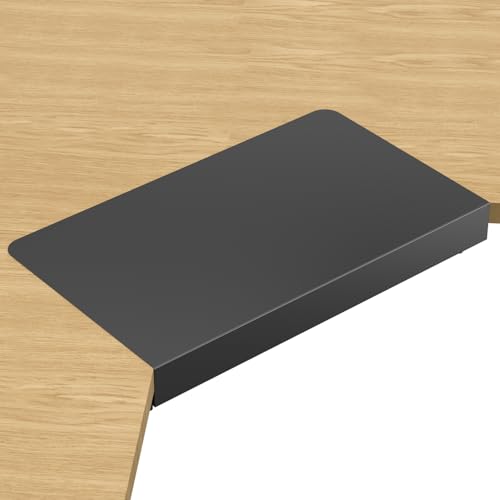 Suptek 17-inch Black Corner Mounting Bracket |
8.9/10 | Buy |
| Best Value |
 Clamp on Desk Corner Sleeve with Drawer |
7.8/10 | Buy |
A Practical Guide to Organizing an L-Shaped Desk Setup
Mastering how to organise an l shaped desk begins by treating the dual-surface footprint as a deliberate ergonomic cockpit rather than an oversized catchall table. When you configure the two desktop wings with dedicated workflows in mind, you prevent physical fatigue and eliminate everyday clutter. This strategic layout ensures that every monitor, peripheral, and writing tool has an assigned resting place aligned with your natural range of motion.
Dividing the Desktop into Primary and Secondary Workflow Zones
The most effective layout strategy relies on separating daily tasks into two distinct desktop zones. Your primary zone should house your core computer setup, including your main monitor, primary keyboard, and mouse. Placing these high-usage tools directly in front of your seated center of mass prevents asymmetrical shoulder rotation and keeps your wrists in a neutral alignment. The secondary wing, often called the return, should be reserved for reference materials, tablet devices, notebooks, or secondary peripherals.
Maintaining this strict division prevents active project materials from spilling into your primary digital input space. When you need to transition from typing to signing physical paperwork or taking video calls, you simply swivel your chair toward the return wing. This deliberate separation creates clear psychological boundaries between varied tasks, helping you maintain focus throughout lengthy work sprints. It also keeps your core typing zone clean, ensuring that loose notes never impede your mouse tracking.
Dominant hand orientation should heavily influence which wing becomes your primary computing hub. Right-handed professionals often benefit from placing the return wing on their right side, providing immediate access to writing surfaces and drawers without crossing their arms. Left-handed users generally experience better physical flow when placing the return surface on their left. Aligning the desk geometry with your natural motor habits minimizes repetitive reach strain and streamlines task switching throughout the day.
Reclaiming the Inner Corner Dead Space with Bridge Platforms
The inner 90-degree intersection of an L-shaped desk often presents the biggest organizational challenge in the entire workstation. In standard corner desks, this deep angle sits outside your primary arm reach, causing items pushed into the corner to be effectively forgotten. Users who attempt to sit directly facing the sharp inside corner frequently discover that their keyboards sit too close, pushing their elbows out and straining the upper back. Bridging this diagonal gap with specialized accessories transforms dead space into high-value functional territory.
Adding a dedicated corner connector platform creates a smooth diagonal transition across the inner right angle. The Suptek 17-inch Black Corner Mounting Bracket is designed specifically to optimize this unused corner area by providing a 16.8-inch by 9.8-inch solid steel platform. This bracket clamps securely to desktop edges up to 1.57 inches thick and includes three clamp sizes to accommodate varying tabletop profiles. By bridging the inner crevice, this platform provides stable physical support for mounting under-desk keyboard trays, docking compact laptops, or creating a centralized input zone.
When small office supplies threaten to clutter your desktop, integrating built-in storage at the corner junction keeps surfaces clear. The Clamp on Desk Corner Sleeve with Drawer offers a screw-free mounting drawer suspended directly beneath a sturdy corner sleeve. Operating on smooth ball bearing sliding tracks with an integrated handle, the drawer safely conceals pens, sticky notes, charging cables, and small electronics without requiring permanent holes in your desktop. It includes two interchangeable clamping knobs, allowing a secure fit on tables with or without a structural front crossbar.
Installing these bridge attachments eliminates the awkward void between perpendicular table sections and restores natural posture. Because these platforms clamp directly to the desk edge, you can adjust their placement along the junction without damaging the finish of your furniture. They allow you to pull your chair closer to the corner apex without hitting sharp table corners or bruising your thighs against frame brackets. This diagonal seating option gives you balanced viewing angles toward both the left and right wings of your workstation.
Configuring Multi-Monitor Displays and Ergonomic Sightlines
Screen placement on an L-shaped surface dictates your upper body posture and determines how smoothly you move between software applications. Two primary strategies govern monitor positioning on corner desks: the corner apex orientation and the straight wing orientation. Mounting your primary screen directly across the inner corner bridge provides a panoramic perspective where secondary displays flank your peripheral vision. Alternatively, placing your primary monitor on the longer wing and using the return wing strictly for vertical secondary displays reduces continuous neck rotation during prolonged typing sessions.
Heavy dual-monitor arms require careful structural verification before clamping them to an L-shaped desktop. Many motorized corner desks feature steel support rails or junction brackets running directly beneath the rear tabletop edge. Before securing high-tension C-clamps, inspect the underside of your desktop to ensure the clamp pads seat completely flat against the substrate rather than teetering on a frame rail. If your desk has a rear decorative bevel or an under-desk crossbeam, you may need a grommet mount or an offset mounting plate to prevent structural deflection.
Maintaining proper focal distance prevents involuntary forward head posture and cervical spine tension. Your primary display should sit approximately an arm’s length away, with the top third of the screen resting at or slightly below eye level. When arranging secondary monitors along the return wing, angle them inward in a subtle arc to maintain consistent focal depth from your resting eye position. This curved layout allows you to glance at email dashboards or project charts with small ocular movements rather than severe neck rotations.
Proper hardware selection makes setting up these complex multi-display workstations far more straightforward. If you are configuring a sit-stand corner frame for the first time, exploring easy assembly desk workstations can help you understand how pre-aligned frame components simplify monitor mounting and structural stability. Ensuring your desk frame provides stable support across both wings keeps your screens from wobbling or shaking whenever you type at standing heights.
Routing Cables Across Dual Spans and Height-Adjustable Frames
Managing electrical wires across an L-shaped desk is substantially more complex than organizing a standard rectangular surface. You must account for cables traveling along two perpendicular horizontal axes, as well as vertical travel paths if you use a sit-stand frame. Unchecked cables quickly form a tangled web beneath the corner junction, creating severe snag hazards that can rip computer ports or unseat delicate display connectors. A disciplined cable strategy groups wires into logical channels that follow the structural lines of the desk frame.
Centralizing your primary power distribution at the inner corner junction minimizes the total distance wires must travel across both wings. Mounting a heavy-duty surge protector beneath the junction bracket provides an accessible anchor point for computer power cords, monitor bricks, and peripheral chargers. Run horizontal under-desk wire trays or magnetic raceways along the bottom of both wings, directing all peripheral leads toward this centralized power core. Securing loose wires with reusable hook-and-loop ties inside these channels keeps your legroom open and visually clean.
Motorized L-shaped desks require dedicated dynamic slack loops to handle vertical height transitions safely. When raising a corner sit-stand desk from seated height to maximum standing elevation, cables running from wall outlets to the desk can stretch and pull tight. Fasten the main power feed to a stationary anchor near the base of the central lifting column before routing it upward through an articulated cable spine. Always test the full travel stroke of the desk slowly while visually confirming that no display cables or power leads catch on crossbars or corner brackets.
Planning your wiring paths in advance also prevents motor strain and electrical communication errors on multi-leg frames. If you are comparing motorized models, reviewing budget-friendly electric standing desks will highlight how multi-motor control boxes manage synchronized lifting columns without pinching under-desk harnesses. Maintaining organized cable bundles ensures that digital control cables remain firmly connected, preventing system leveling faults and frustrating error code lockouts.
Preserving Knee Swing and Under-Desk Leg Clearance
A well-organized desktop is useless if the space underneath is so cramped that your legs cannot move freely between wings. L-shaped workstations naturally encourage users to swivel back and forth between tasks, which requires an unobstructed arc for your knees and feet. Placing bulky computer towers, wastebaskets, or heavy storage boxes directly beneath the inner corner creates an immediate obstacle course that bruises shins and restricts natural postural adjustments. Keeping the central swivel radius completely open is fundamental to ergonomic comfort.
Storage accessories should be positioned strategically at the outer perimeter of the return wing rather than near the central pivot. Mobile filing cabinets and drawer pedestals function best when tucked against the far end of the secondary wing, where they will not interfere with your chair caster roll paths. If you need immediate access to writing utensils and small tools, choose low-profile clamp-on storage like the Gaxomo corner sleeve drawer that hangs closely against the desktop without intruding into your knee space. Hanging storage keeps your desk supplies within reach while preserving valuable floor real estate below.
Floor accessories such as footrests and anti-fatigue mats require thoughtful placement to accommodate movement across both wings. If you frequently alternate between sitting and standing, use a compact anti-fatigue mat that easily slides aside when you transition back to your office chair. Position any ergonomic footrest so that it aligns squarely with your primary keyboard zone rather than sitting at an awkward diagonal angle. This dedicated alignment ensures your feet remain flat and fully supported, preventing uneven pelvic tilt and lower back fatigue during long working hours.
Implementing Surface Decluttering and Daily Workstation Discipline
The expansive surface area of an L-shaped desk often tempts users to treat every square inch as permanent storage. Over several days, coffee mugs, loose mail, spare cables, and notebooks accumulate across both wings, turning an executive workstation into a chaotic mess. Preventing surface creep requires setting firm spatial boundaries for what qualifies as permanent desktop equipment versus temporary task materials. A strict policy of keeping at least sixty percent of your total desktop surface completely clear promotes mental clarity and efficient workflow execution.
Vertical desktop organizers and modular desk pads help maintain these critical surface boundaries. Placing a high-quality desk pad in your primary computing zone defines the boundaries of your keyboard and mouse tracking area, preventing miscellaneous items from encroaching on your hands. Use vertical document sorters on the far edge of the return wing to store active project files upright rather than stacking them horizontally across the table. Elevating your desktop audio speakers or webcams on small clamp-on risers further clears table surface area for active tasks.
Establishing a three-minute end-of-day reset routine ensures that your organized system remains sustainable over the long haul. Before shutting down your computer, return all loose writing utensils to their under-desk drawer compartments and file away finished paper documents. Wipe down high-contact zones and push your office chair flush against the desk frame so that your workspace looks inviting when you return the next morning. Developing this consistent closing habit ensures your workstation remains an efficient, productive hub every single day.
Organizing an L-shaped desk successfully is not about buying endless organizer bins; it is about building an intentional workflow environment that respects human biomechanics. By establishing dedicated primary and secondary zones, reclaiming the central corner dead space with sturdy bridge platforms, and securing electrical wires safely, you create a workstation that actively supports your daily output. Protect your lower body comfort by keeping knee paths open, and practice routine decluttering discipline to preserve your open surface space. When every physical element serves a defined purpose, your workstation becomes a calm, powerful center for focused professional achievement.
About the author
Arriana Vasquez is a product writer specializing in work-from-home equipment and practical workspace solutions. Her reporting covers office chairs, standing desks, and technology designed for modern home offices. Through product research, testing, and detailed buying guides, she explores the features that influence everyday usability, comfort, and functionality. Her work helps readers compare workspace equipment and identify products suited to different working environments.