
How to Raise a Desk: A Practical Guide for 2026
Learn how to raise a desk for better home office ergonomics, posture support, and comfortable sit-stand transitions in October 2026.
 By Camryn Rabideau
Updated October 9, 2026
By Camryn Rabideau
Updated October 9, 2026

Long working hours spent in a static seated posture frequently lead to lower back tension, stiff shoulders, and midday fatigue. Many professionals seek effective ways to modify an existing workstation rather than replacing an entire furniture suite. Understanding How To Raise A Desk allows you to introduce healthy movement into your daily work routine without discarding a sturdy desktop. By lifting your work surface to an optimal level, you can keep your spine neutral and encourage continuous physical engagement throughout the day. This balance between seated focus and standing relief helps support long-term musculoskeletal wellness.
Adapting an existing workspace does not have to be complicated or technically overwhelming. Whether you choose an adjustable desktop converter, pneumatic riser, or modular lift, the primary objective is achieving proper elbow and neck alignment. Reviewing our comprehensive standing desk workstation guide reveals how simple posture adjustments reduce chronic fatigue. Taking time to select the right lifting mechanism ensures your workstation remains stable, supportive, and perfectly aligned with your daily productivity requirements.
| Award | Product | HOF Score About HOF ScoreThe HOF Score is our own rating from 0 to 10, based on performance, design and build, ease of use, and value. It reflects independent research and is never influenced by manufacturers, retailers, or affiliate commissions. Learn more › | |
|---|---|---|---|
| Best Overall |
 Amazer 22 inch Standing Desk Converter
|
9.2/10 | Buy |
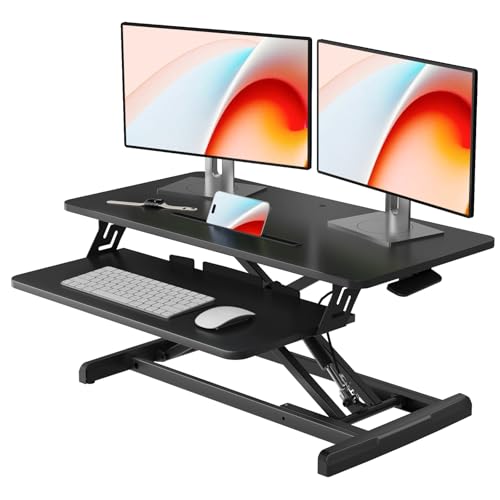 JOY worker Standing Desk Converter
|
8.8/10 | Buy | |
 TechOrbits Black 32 in Standing Desk Converter
|
8.6/10 | Buy |
Practical Solutions for Raising Your Existing Desk to Standing Height
Elevating a standard desk to a healthy standing level requires balancing mechanical stability, weight distribution, and proper ergonomic dimensions. Rather than forcing a static compromise, the most effective approach adapts your current surface using purposeful lifting equipment. You can transform a conventional seated setup into a versatile sit-stand workstation by matching your personal height requirements to the right converter mechanism.
Determining Your Target Ergonomic Working Height
Finding your correct standing height begins with the neutral ninety-degree elbow rule. Stand naturally with relaxed shoulders, drop your arms to your sides, and bend your elbows at a right angle parallel to the floor. The distance from the floor to the underside of your forearms establishes your target typing surface height. If you stand barefoot during home workdays, measure without shoes, but remember to factor in shoe sole thickness or an anti-fatigue mat if you use one regularly.
Your display positioning requires equal precision to prevent persistent cervical spine strain. When standing at full height, the top third of your computer monitor should rest directly at eye level. This alignment allows your gaze to cast downward at an angle of roughly fifteen to twenty degrees toward the center of your screen. When your monitor sits too low, your neck bends forward, placing unnecessary mechanical stress on your upper back muscles and spinal discs.
Measuring your existing desk height reveals the exact vertical travel distance your lifting solution must provide. Most standard home office desks feature a fixed height between twenty-eight and thirty inches from the floor. Subtracting your desk height from your target typing height indicates the vertical stroke your converter must achieve. Choosing an elevating accessory with insufficient maximum travel will force you into an awkward, hunched posture that defeats the purpose of standing.
Desktop Risers and Standing Desk Converters Explained
Standing desk converters represent the most accessible and reliable method for raising an existing workspace. These units sit directly on top of your existing desktop, utilizing mechanical linkages or gas-spring cylinders to lift your keyboard, mouse, and monitors smoothly. A dual-tier design keeps your hands at an ideal typing height while elevating your display independently. This multi-level separation preserves neutral wrist posture while simultaneously keeping your neck upright.
Mechanical gas-spring risers allow near-effortless adjustments using integrated squeeze handles. Units such as the JOY worker Standing Desk Converter utilize a patented X-shaped frame that elevates your gear smoothly between 4.9 inches and 19.3 inches above your desk surface. Similarly, the TechOrbits Black 32 in Standing Desk Converter relies on a pneumatic lift mechanism to provide vertical travel from 4.3 inches to 19.7 inches. These pneumatic assists take on the physical strain of lifting heavy computing equipment, allowing fast transitions throughout your workday.
Modular bamboo risers offer a lightweight and minimalist alternative to pneumatic metal frames. The Amazer 22 inch Standing Desk Converter utilizes eco-friendly bamboo side panels with circular stabilizer bars to support monitor loads up to 44 pounds. This style lowers to a minimum seated height of 7.2 inches from the desktop, offering tiered slots for customized shelf placement. Its convertible lap desk functionality also provides cushioned support if you prefer working from a lounge chair or sofa between standing sessions.
Step-by-Step Installation for Desktop Converters
Setting up a standing desk converter requires clear surface preparation and careful hardware staging. Begin by clearing all accessories, lamps, and computer peripherals away from your primary desktop surface. Wipe down the desktop to remove dust and debris that could cause the converter base pads to slip or scratch the finish. Check that your desk base rests firmly on the floor without rocking before introducing additional hardware.
Pre-assembled pneumatic converters require very little manual intervention before initial operation. Most units arrive with the scissor frame and main work surface already joined at the factory. For models featuring a tiered keyboard deck, you typically only need to attach the lower shelf brackets using the included fasteners. If you prefer low-friction workstation adjustments, exploring straightforward assembly standing desk options helps simplify your overall office upgrade process.
Modular slot-together bamboo converters assemble without complex mechanical tools or metal screws. The Amazer converter connects precision-milled bamboo side panels using circular stabilizer bars that lock into place by hand. Once the triangular frame structure is assembled, slide the primary monitor shelf and secondary keyboard tier into the corresponding side grooves. Always verify that both sides of each shelf rest evenly in matching slots to prevent screen tilt or accidental slippage.
Weight Capacity and Equipment Load Distribution
Exceeding the rated load capacity of a desk riser creates severe mechanical instability and risks equipment damage. Every lifting unit specifies distinct payload limits for both the main platform and the keyboard shelf. The TechOrbits Black 32 in converter supports up to 33 pounds of hardware across its aluminum frame, accommodating standard laptops, monitor arms, and desktop accessories. The JOY worker model supports up to 28.6 pounds on its upper tier and 4.4 pounds on its keyboard platform, which easily handles standard dual-screen setups.
Concentrating heavy hardware too far toward the front or rear edge alters the unit center of gravity. Position your heaviest monitors near the center line of the top platform to balance the load evenly across the scissor lift or stabilizing legs. Heavy items placed on an extended keyboard tray can generate excessive leverage, causing pneumatic mechanisms to drop unexpectedly. Distribute peripheral weights symmetrically to avoid putting uneven torque on mechanical hinges and guide rails.
Calculating total equipment weight requires adding every device resting on the converter tiers. Combine the weight of your computer displays, monitor mounting brackets, laptop, external keyboard, mouse, and audio speakers. Avoid resting heavy books or leaning your body weight heavily onto the keyboard shelf while typing. Keeping your working payload safely within the stated manufacturer capacity ensures smooth vertical motion and prevents premature wear on lifting springs.
Managing Monitor Wobble and Frame Deflection
Typing-induced screen wobble is a common frustration when working at elevated standing heights. When a desk riser extends to its maximum vertical stroke, small vibrations from your hands transfer directly through the frame to the display. Sturdy frame geometry plays a vital role in dampening these unwanted oscillations during active typing sessions. Models built with reinforced X-shaped frames or triangulated bamboo side panels resist twisting forces much better than basic single-column risers.
Desk stability beneath your converter represents the foundation for vibration resistance. Even the most rigid desktop riser will shake if your existing table legs have loose fasteners or uneven leveling glides. Inspect your primary desk frame, tightening all leg-to-top bolts and adjusting the bottom foot pads until the desk sits completely flat. Placing your desk against a solid wall or repositioning it on a firm floor mat can also significantly reduce lateral sway.
Attaching external monitor arms directly to a desktop converter requires extra caution. Many converter platforms are manufactured from engineered particle board or layered bamboo with specific thickness profiles. High-tension C-clamps can concentrate intense point loads onto thin edges, potentially crushing the wood core or causing forward tilt. If you utilize a clamp-style monitor arm, place a metal reinforcement plate between the clamp and the platform surface to spread the clamping pressure evenly.
Dynamic Cable Routing and Travel Slack Clearance
Raising your desk surface introduces dynamic movement that can snag, pull, or unplug connected electrical cords. Power cords, display cables, and USB connections must have adequate length to travel from the floor or wall up to the highest riser elevation. If a cable becomes taut before the converter reaches full extension, the mechanical lift can bend connector pins or yank devices off your desk. Always measure cable runs with the converter fully elevated before bundling cables into permanent sleeves.
Securing cables with dedicated clips prevents them from tangling within moving mechanical hinges. The Amazer bamboo converter includes built-in cable management clips on the rear frame and grooved stabilizer bars for hanging headphones and wires. For pneumatic scissor-lift models, run cables along the central support arms rather than the outer scissor joints where pinching can occur. Use flexible hook-and-loop straps rather than tight plastic zip ties so cords can flex naturally during daily height adjustments.
Mounting a multi-outlet surge protector directly beneath or behind your workstation simplifies cable organization. When all your peripheral equipment connects to a centralized power strip on the desk, only a single master power cord travels down to the wall outlet. This centralized setup eliminates cord clutter, prevents trip hazards, and protects expensive electronics from sudden tension damage. Inspect cable pathways regularly to confirm that no wires rub against sharp metal edges during height transitions.
Evaluating Alternative Workstation Elevation Techniques
While desktop converters offer the simplest retrofitting solution, other methods exist for raising an existing work surface. Heavy-duty furniture risers placed under your desk legs can elevate a static table by several inches. This approach works well if your desk sits only slightly too low for comfortable seated typing, but it lacks the dynamic flexibility required for frequent sit-stand transitions. Leg bed risers can also compromise structural stability if your desk carries a heavy multi-monitor computer setup.
Swapping your static desk base for an adjustable motorized frame provides an expansive, whole-surface lifting solution. You can detach your existing tabletop from its original legs and mount it directly onto an electric dual-motor or single-motor frame. If you want to explore motorized upgrades, reviewing our recommendations on affordable motorized standing frames will highlight cost-effective frames that provide broad height travel. This full-frame conversion lifts your entire desktop, eliminating the tiered footprint of a desktop riser.
Dedicated keyboard trays with articulating arms offer another method for fine-tuning working heights. An under-desk tray mounts beneath your desktop on sliding tracks, allowing you to lower or angle your typing surface below the main table height. However, standard under-desk trays cannot raise your keyboard high enough for standing work. They serve primarily as seated ergonomic enhancers rather than comprehensive sit-stand transition tools.
Posture Transitions and Sit-Stand Ergonomic Habits
Raising your desk is only the first step toward building a healthy and energizing ergonomic routine. Standing statically for eight consecutive hours places excessive pressure on your feet, knees, and lower spinal discs. Ergonomic specialists often recommend the twenty-eight-two routine, which involves sitting for twenty minutes, standing for eight minutes, and moving or stretching for two minutes. Breaking up sedentary periods with brief standing intervals stimulates circulation without causing physical fatigue.
Paying close attention to your standing posture prevents secondary aches and joint discomfort. Stand with your feet spread shoulder-width apart, keeping a soft bend in your knees rather than locking your joints backward. Shift your weight periodically between your feet, or rest one foot on an elevated footrest bar to relieve tension in your lumbar spine. Maintaining relaxed shoulders and neutral wrists while typing ensures your upper body remains free of unnecessary tension.
Pairing your elevated desk with a supportive anti-fatigue mat cushions your joints and encourages subtle muscle contractions. High-density polyurethane foam mats reduce the impact of hard flooring on your heels and lower back. When combined with a responsive desktop converter, an anti-fatigue mat creates a comfortable and sustainable workstation environment. Gradual adaptation allows your core and postural muscles to build endurance naturally over several weeks.
Routine Maintenance and Practical Verification
Regular hardware inspection ensures your elevated workstation continues to operate reliably without unexpected wobbles. Mechanical desktop converters experience repetitive stress from daily elevation cycles and continuous typing pressure. Take time every few months to inspect frame pivot points, hinge pins, and keyboard tray brackets. Tightening any loose screws or bolts restores structural rigidity and prevents subtle frame shifting that can wear out internal gas springs.
Maintaining clean contact surfaces preserves the smooth movement of pneumatic cylinders and sliding channels. Dust, pet hair, and small office debris can accumulate around scissor linkages, causing friction or squeaking noises over time. Wipe down metal guide rails with a soft dry microfiber cloth, avoiding heavy chemical cleaners that could degrade protective surface coatings. For bamboo converters, check the integrity of the stabilizer bars and wipe the wood surfaces along the natural grain.
Elevating your existing desk to an ergonomic height bridges the gap between static seated work and active physical comfort. By selecting a stable lifting converter, distributing equipment weight properly, and establishing dynamic sit-stand habits, you can create a healthier home office environment. Take the time to measure your personal elbow height accurately and verify adequate cable slack before completing your setup. A properly adjusted workstation supports your productivity and physical well-being across every working hour.
About the author
Camryn Rabideau is a freelance writer and product reviewer with a background in product design and journalism. Since becoming a full-time freelance writer in 2016, she has developed extensive experience researching and testing consumer products for the home. Her work focuses on practical product performance, usability, and purchasing considerations. Her combination of product design knowledge and hands-on testing experience provides a useful perspective on furniture, household products, and everyday living.