
How High Should a Desk Chair Be? Practical Workstation Guide for 2026
Learn how high should a desk chair be for ergonomic comfort in October 2026, covering seat measurements, desk alignment, and posture support.
 By Arriana Vasquez
Updated October 10, 2026
By Arriana Vasquez
Updated October 10, 2026

Establishing the correct seating height forms the foundation of all healthy workstation ergonomics. Many remote professionals struggle with persistent lower back tightness and shoulder fatigue simply because their seating position fails to align with their work surface. When exploring how high should a desk chair be, your primary physical benchmark must begin with your body measurements rather than arbitrary furniture dimensions. Proper seating elevation allows your feet to plant securely while your forearms rest naturally parallel to your work surface. If you are refining your overall home office desk setup, coordinating your seating height with your desktop elevation will immediately reduce spinal strain.
The ideal chair height changes noticeably depending on whether you work at a fixed standard desk or a height-adjustable sit-stand workstation. Standard desks accommodate regular task chairs with moderate elevation cylinders, whereas elevated workstations often require taller drafting chairs equipped with sturdy foot rings. A collapsing pneumatic cylinder can also ruin your posture by letting your seat slowly drop throughout the workday. Getting your seating level right protects your lumbar spine, prevents hip pinching, and keeps your wrists in a neutral position for long typing sessions. Taking a few minutes to calculate your exact measurements will help you avoid discomfort and stay productive all day.
| Award | Product | HOF Score About HOF ScoreThe HOF Score is our own rating from 0 to 10, based on performance, design and build, ease of use, and value. It reflects independent research and is never influenced by manufacturers, retailers, or affiliate commissions. Learn more › | |
|---|---|---|---|
| Best Overall |
 DUMOS Ergonomic Drafting Chair
|
9.2/10 | Buy |
| Best Value |
 500LBS Drafting Chair, High Back Safer Standing
|
8.9/10 | Buy |
| Best Budget |
 Salbree Office Chair Hero Clamp Sinking Fix
|
8.6/10 | Buy |
| Best Premium |
 BOLISS Drafting Tall Office Chair 400lbs High Back
|
8.6/10 | Buy |
 Spidfee Fix Sinking Office Chair
|
8.1/10 | Buy | |
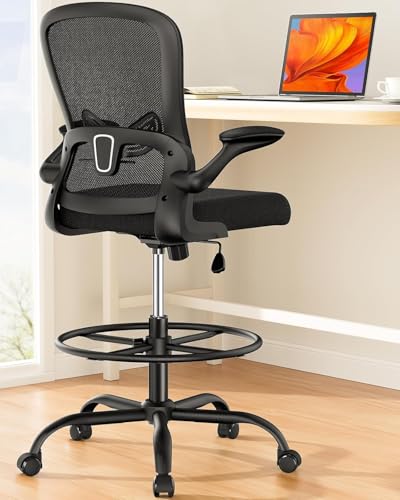 ErGear Drafting Chair with Footrest Ring
|
8.1/10 | Buy | |
 Marsail Drafting Chair, Tall Office Chair with 2D
|
7.8/10 | Buy |
Ergonomic Principles for Determining Your Ideal Desk Chair Height
Determining how high should a desk chair be requires balancing your individual body dimensions against the fixed or adjustable height of your work surface. An improperly configured seat places excessive pressure on your sciatic nerve, strains your upper back, and forces your wrists into awkward typing angles. Achieving the correct elevation involves measuring your leg length, evaluating your elbow alignment, and choosing a chair with sufficient cylinder stroke to match your desk. Setting your chair to support neutral body mechanics eliminates postural fatigue and keeps you working comfortably throughout the day.
The Popliteal Measurement Formula for Lower Body Alignment
The primary reference point for establishing proper chair height is your popliteal measurement, which represents the distance from the floor to the crease behind your knee. When seated, your chair cushion should rest at or slightly below this anatomical marker to support your legs without pinching nerves. If your seat is adjusted too high, the front waterfall edge of the cushion compresses the underside of your thighs. This compression restricts blood circulation, causes numbness in your lower legs, and increases swelling over long working shifts.
To calculate this measurement accurately, wear your typical work footwear and sit on a flat surface with your knees bent at a 90-degree angle. Measure vertically from the floor to the underside of your knee crease to establish your target seat pan elevation. High-density molded foam cushions will compress slightly under body weight, so verify your measurement while seated with your full weight on the cushion. Your feet must remain completely flat on the floor to distribute your weight evenly across your thighs and feet.
Synchronizing Chair Elevation with Desk Surface and Elbow Height
Once your lower body is properly positioned, your chair elevation must coordinate seamlessly with the height of your desk. Your working elbow height dictates where your keyboard and mouse should sit in relation to your torso. When your shoulders are relaxed and your elbows bend at roughly 90 degrees, your forearms should extend parallel to the desktop surface. If your desk sits too high relative to your chair, you will be forced to elevate your shoulders or flare your elbows outward to type.
Persistent shoulder elevation creates chronic tension along your trapezius muscles and neck, leading to tension headaches by mid-afternoon. Conversely, setting your chair too high causes you to hunch forward over your keyboard, rounding your thoracic spine and straining your lower back. When working at a conventional fixed desk that measures between 28 and 30 inches tall, you may need an ergonomic footrest underneath your feet to maintain proper elbow level without dangling your legs. Exploring resources on understanding standing desk ergonomics can help you see how full height adjustability eliminates this compromise entirely.
Standard Office Chairs Versus Tall Drafting Chairs for Standing Desks
Standard ergonomic office chairs are engineered specifically for traditional desk heights, typically providing a seat adjustment range from 16 to 21 inches from the floor. This travel window fits the vast majority of seated desks but falls short when paired with elevated workstations or drafting tables. Height-adjustable sit-stand desks often operate between 28 and 48 inches of total elevation. If you want the flexibility to sit or perch without repeatedly lowering your standing desk frame to the bottom of its travel stroke, a standard task chair is simply too low.
Tall drafting chairs solve this dilemma by incorporating extended hydraulic gas lift cylinders that significantly expand vertical reach. For example, the BOLISS drafting chair features an extended 7.3-inch hydraulic lift range spanning from 24.8 to 32.1 inches, making it suitable for high workstations and bar-height tables. Similarly, models like the Sofetura high-back chair offer a seat height span between 22.4 and 28.3 inches, while the Marsail drafting chair reaches up to 30.7 inches with an adjustment range of nearly 8 inches. Pairing an extended drafting chair with budget electric standing desks gives you the option to perch at standing height or transition smoothly between tasks.
The Critical Role of Adjustable Foot Rings on Counter-Height Chairs
Elevating a chair above 22 inches inevitably removes your feet from contact with the floor, creating an urgent ergonomic need for dedicated foot support. An integrated metal foot ring is an essential structural component on any tall drafting chair. Without a stable foot ring, the entire weight of your lower legs pulls downward against the front edge of the seat pan. This concentrated pressure quickly cuts off venous return, resulting in heavy legs, fatigue, and potential nerve irritation.
The diameter and adjustability of the foot ring directly influence your daily comfort while seated at higher levels. Designs like the ErGear drafting chair provide a wide 19.7-inch foot ring with 5 inches of vertical adjustment, while the DUMOS drafting chair incorporates a 17.7-inch diameter metal ring. Having vertical adjustability on the ring allows you to replicate the exact 90-degree knee bend you would enjoy with your feet flat on the floor. Resting your feet securely on the ring anchors your posture, prevents you from sliding forward, and promotes healthy circulation throughout extended work sessions.
Clearance Planning and Space Management with Flip-Up Armrests
Managing the physical space between your chair armrests and the underside of your desk is essential for maintaining proper seated posture. Fixed armrests often collide with the front edge of the desk or lower crossbars, preventing you from pulling your chair close to your keyboard. When your chair cannot slide forward, you are forced to lean over the gap, completely negating the benefits of your ergonomic backrest. This postural disconnect causes upper spine fatigue and strains the lower back over hours of desk work.
Modern drafting chairs frequently resolve this clearance issue by integrating 90-degree flip-up padded armrests. Both the BOLISS and ErGear tall chairs feature flip-up arm designs that rotate vertically out of the way on demand. Folding the armrests upward allows you to slide your chair directly beneath the work surface when typing and tuck the chair completely away during standing sessions. Models like the DUMOS drafting chair offer armrest floor clearance between 26.6 and 30.3 inches, giving you flexible positioning whether working at standard surfaces or elevated drafting tables.
Diagnosing and Repairing Sinking Gas Lift Cylinders
One of the most frustrating obstacles to maintaining correct chair height is a failing pneumatic gas lift cylinder. Over months or years of regular use, internal cylinder seals can degrade and allow pressurized nitrogen gas to escape slowly. The classic symptom is a chair that slowly sinks to its lowest position whenever you sit down, only to rise back up when you stand. Working on a sinking chair continuously throws off your ergonomic alignment, dragging your elbows below desk level and straining your shoulders.
Mechanical fix kits provide an inexpensive and immediate way to lock your chair height permanently without replacing the entire cylinder. The Salbree Office Chair Hero clamp system uses high-strength injection-molded plastic segments that snap directly onto the cylinder rod, supporting up to 600 pounds across 15 height combinations. Alternatively, the Spidfee sinking chair fix utilizes a durable stainless steel clamp that tightens around standard 25 to 28 millimeter cylinders using an integrated handle. Installing a mechanical stop collar restores rock-solid height stability in minutes, saving the expense and hassle of discarding a comfortable chair.
Ergonomic Nuances for Petite and Tall Body Proportions
Standard chair height guidelines provide a useful baseline, but individual body proportions require tailored adjustments for optimal comfort. Petite individuals often find that even standard office chairs do not adjust low enough to place their feet flat on the ground. If your popliteal height is under 16 inches, you must choose a chair with an ultra-low minimum seat height or pair your chair with an elevated foot platform. Failing to support shorter legs causes continuous pelvic tilting, leading to lumbar strain and premature fatigue.
Tall workers face the opposite challenge, requiring chairs with extended vertical travel and taller backrests to support their upper spine. The Sofetura 500-pound drafting chair features an extended 25.2-inch high backrest specifically designed to cradle the thoracic spine of taller individuals. Adjustable lumbar features, such as the 2D lumbar support on the Marsail drafting chair and the 2-inch vertical lumbar adjustment on the ErGear chair, ensure proper spinal alignment regardless of torso length. Selecting a chair with heavy-duty construction and a reinforced five-star base guarantees safety and stability at maximum elevation.
Integrating Chair Height Adjustments into an Active Sit-Stand Routine
Finding your perfect chair height is not an isolated task; it is part of a broader strategy for maintaining physical energy throughout your workday. Ergonomists frequently emphasize the Cornell 20-8-2 routine, which recommends sitting for 20 minutes, standing for 8 minutes, and moving or stretching for 2 minutes every half hour. Alternating your posture prevents static muscle fatigue, stimulates circulation, and relieves pressure on your lumbar discs. Setting memory presets on your adjustable desk for both your seated elbow level and standing elbow level makes this cycle effortless to sustain.
Your optimal standing desk height will differ from your seated desk height, but the fundamental elbow rule remains identical. When standing, your desk should rise to meet your elbows at the same 90-degree angle, with your wrists resting flat on your input devices. Using a tall drafting chair also lets you introduce perching as an intermediate posture between sitting and full standing, relieving lower back pressure while keeping your feet anchored on the foot ring. Taking time to fine-tune your chair elevation and desk presets ensures your workspace actively supports your daily comfort and productivity.
About the author
Arriana Vasquez is a product writer specializing in work-from-home equipment and practical workspace solutions. Her reporting covers office chairs, standing desks, and technology designed for modern home offices. Through product research, testing, and detailed buying guides, she explores the features that influence everyday usability, comfort, and functionality. Her work helps readers compare workspace equipment and identify products suited to different working environments.