
How Much Leg Space Under Desk: Clearance Guide for 2026
Learn how much leg space under desk setups require for comfort in October 2026, covering standard depth, height, width, and ergonomic accessories.
 By Camryn Rabideau
Updated October 9, 2026
By Camryn Rabideau
Updated October 9, 2026

Planning an ergonomic workstation requires understanding physical dimensions before adding hardware, storage units, or foot accessories. When setting up a workstation, knowing how much leg space under desk surfaces is necessary prevents restricted blood flow, cramped knees, and poor posture throughout the workday. Whether arranging a standard executive desk or integrating adjustable height standing desks, maintaining uninhibited clearance allows for natural movement and proper spinal alignment. Restricted leg room frequently leads to awkward hip angles, hunched shoulders, and unnecessary muscle tension.
Proper lower-body clearance also dictates what ergonomic accessories you can comfortably position beneath your work surface. From supportive footrests to movement steppers, planning your dimensions ensures these tools enhance comfort rather than crowd your lower limbs. Evaluating a dedicated home office workstation setup requires balancing desk width, depth, and vertical clearance to accommodate your seating habits and equipment. Assessing your space early keeps your daily routine productive and physically comfortable.
| Award | Product | HOF Score About HOF ScoreThe HOF Score is our own rating from 0 to 10, based on performance, design and build, ease of use, and value. It reflects independent research and is never influenced by manufacturers, retailers, or affiliate commissions. Learn more › | |
|---|---|---|---|
 Everlasting Comfort Foot Rest for Under Desk at
|
8.3/10 | Buy | |
| Best Value |
 YEASHEIN Adjustable Foot Rest for Under Desk at
|
8.9/10 | Buy |
 VIVO Mobile Under Desk Leg Rest
|
8.3/10 | Buy | |
 VIVO Adjustable Under Desk 16 x 12 inch Leg Shelf
|
8.8/10 | Buy | |
 Mount-It! Foot Rest Under Desk, Chrome Legs
|
8.3/10 | Buy | |
| Best Premium |
 Everlasting Comfort Foot Rest for Under Desk at
|
9.1/10 | Buy |
| Best Overall |
 Sunydog Foot Stepper Machine (One Size)
|
9.2/10 | Buy |
| Best Budget |
 Sunydog Foot Stepper Machine (One Size)
|
8.6/10 | Buy |
Ergonomic Leg Clearance Standards and Workstation Dimensions
Determining exactly how much lower-body clearance your setup requires is essential for maintaining comfort and preventing muscle fatigue. According to standard ergonomic guidelines, a standard seated workstation requires at least 20 to 24 inches of width, a minimum vertical height of 24 to 28 inches from the floor to the underside of the surface, and a total depth of 15 to 24 inches depending on knee and foot extension. Without these baseline dimensions, your knees frequently bump into support beams, your thighs press against desk aprons, and your feet remain trapped in awkward positions. Ensuring your setup meets these minimum thresholds allows for continuous, healthy postural adjustments throughout long computer sessions.
Standard Dimensional Requirements for Knee and Foot Clearance
Professional ergonomic standards such as BIFMA G1-2017 outline clear dimensional envelopes for comfortable computer work. For lateral space, an unencumbered opening of at least 24 inches allows your legs to shift naturally without striking side gables or mechanical legs. If you prefer crossing your legs or shifting between seated angles, increasing that width to 30 inches provides optimal freedom. Restricting width below 20 inches forces static hip abduction, which can contribute to lower back tightness and reduced circulation over time.
Vertical clearance requires careful attention because the thickness of your desktop directly impacts your usable space. A person sitting with their feet flat on the floor generally needs between 24 and 27 inches of vertical clearance measured from the floor to the lowest obstruction beneath the work surface. When calculating this distance, you must measure to the lowest under-desk crossbar, keyboard tray bracket, or drawer unit rather than the top surface. Maintaining at least 1 to 2 inches of open air between your thighs and the bottom of the desk prevents compression of soft tissue and femoral nerve pathways.
The Difference Between Knee Clearance and Foot Clearance Depth
Workstation depth is divided into two distinct zones that many buyers overlook when measuring their furniture. Knee clearance represents the upper under-desk zone where your patella and lower thighs rest, which typically requires a depth of at least 15 to 17 inches from the front desktop edge. In contrast, foot clearance represents the lower zone along the floor where your feet naturally extend forward or rest flat. Foot depth demands significantly more space, requiring between 23.5 and 24 inches of unobstructed floor depth to accommodate the natural forward slant of your shins.
Desks built with solid modesty panels or built-in rear shelving often cut this foot clearance short, creating an artificial wall that cramps taller individuals. When a rear panel blocks the forward path of your feet, you are forced to tuck your feet backward underneath your chair. This flexed knee posture increases mechanical strain on the patellar tendons and reduces venous blood return from the lower legs. Choosing a desk architecture that keeps the lower footwell completely open preserves critical forward extension and improves overall sitting stamina.
How Desk Frame Architecture Affects Usable Under-Desk Space
The structural design of your desk frame plays a major role in how much accessible legroom you enjoy during the day. Traditional four-leg desks position vertical supports at each corner, creating a box-like perimeter that can restrict wider chair bases or leg-mounted accessories. In modern height-adjustable desks, manufacturers often choose between T-frame and C-frame configurations to support the lifting columns. Following a reliable standing desk assembly guide helps you position frame crossbeams correctly so they do not intrude into your primary seating area.
A C-frame design positions the vertical lifting columns toward the rear edge of the desktop feet, pushing structural steel away from your knees. This architectural choice dramatically opens up the front and center zones under your workstation, making it easier to stretch your legs without striking metal tubes. Conversely, a T-frame centers the vertical column on the bottom foot, which offers balanced static weight distribution but slightly narrows forward knee clearance. If you have long legs or use bulky ergonomic accessories, selecting a frame with rear-offset columns provides maximum open volume.
Integrating Ergonomic Footrests Without Crowding Lower Limbs
Many office workers discover that raising their office chair to achieve a proper 90-degree typing angle leaves their feet dangling without floor support. Adding an ergonomic foot accessory solves this issue, but it also consumes valuable vertical and depth clearance beneath the surface. Compact platforms such as the Mount-It! Foot Rest Under Desk, Chrome Legs occupy a platform footprint of 17 by 11.25 inches, offering a rocking 15-degree tilt on chrome legs with a textured bump surface. This moderate size allows you to rest both feet comfortably while preserving surrounding space for movement.
Soft foam designs introduce a different spatial profile beneath your workspace. The Everlasting Comfort Foot Rest for Under Desk at uses high-density memory foam in a dual-function curved format that can serve as a static elevation cushion or be flipped over as an active rocker. Measuring slightly wider than basic footstools, this accessory requires at least 18 inches of clear lateral width and roughly 12 inches of depth to rest flat on the floor. The non-slip bottom prevents it from sliding into rear cables, keeping your elevation pillow firmly positioned within reach.
Highly adjustable steel-frame platforms offer maximum height customization but demand significant vertical allowance under the desktop. For example, the YEASHEIN Adjustable Foot Rest for Under Desk at features a heavy-duty carbon steel frame measuring 18.7 inches long by 11.9 inches wide, supporting up to 500 pounds across 4 height settings and 2 angle positions ranging from 4 to 10 inches tall. When raising your feet up to 10 inches above the floor, your knees rise proportionally closer to the underside of the desk. You must ensure your desk height can adjust upward to accommodate this elevated knee level without trapping your thighs beneath crossbars.
Accounting for Active Movement Devices and Stepper Machines
Incorporating low-impact movement accessories beneath your work surface helps reduce static sitting fatigue and stimulates lower-body circulation. The Sunydog Foot Stepper Machine (One Size) offers a lightweight, folding solution constructed from reinforced nylon with convex anti-slip massage pedals designed to protect ankle joints. Because of its compact folding footprint, this stepper fits neatly into the center footwell or slides into a desk corner when not in use. However, using an active stepping mechanism requires greater vertical clearance than resting on a flat footstool.
When you pump your legs on a stepping device, your knees travel upward with every stroke cycle. If your work surface sits at a fixed standard height of 28 to 30 inches, this upward pedal motion can cause your knees to bump against the underside of the tabletop. To use an active stepper comfortably while typing, you typically need an additional 3 to 5 inches of vertical clearance above your resting knee height. Motorized workstations make this adjustment effortless by allowing you to raise the work surface slightly while remaining seated during your movement intervals.
Managing Under-Desk Storage Trays and Leg-Mounted Shelves
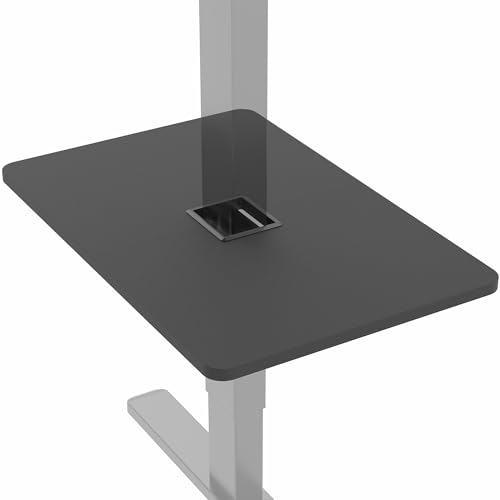
Keeping desktop clutter under control often leads remote workers to install under-desk organizers, drawers, and utility trays. While convenient, storage attachments can severely diminish open space if positioned in the central knee zone. Products like the VIVO Adjustable Under Desk 16 x 12 inch Leg Shelf provide an intelligent storage alternative by mounting directly to lifting columns rather than under the center tabletop. This 15.8 by 11.8 inch platform attaches via an adjustable center clamp designed for legs measuring 2 to 2.8 inches in length and 1.5 to 3.4 inches in width.
Supporting up to 15.4 pounds with its solid steel bracket and particle board shelf, this accessory holds small hardware, notebooks, and accessories completely outside your primary knee path. Clamping utility trays to the outer perimeter or rear surface of desk legs preserves full leg width across the central work area. When mounting any peripheral shelf, verify that it does not project inward toward your chair casters or interfere with your natural leg movements. Strategic placement ensures your essential gear remains accessible without obstructing your lower-body workspace.
Utilizing Mobile Leg Rests and Independent Footstools
For users managing lower back tension, joint stiffness, or circulatory issues, fully elevating the legs while reclining in an ergonomic chair offers substantial physical relief. The VIVO Mobile Under Desk Leg Rest accommodates this need through an independent padded footstool supported by a pneumatic lift that adjusts from 15 to 18.9 inches from the floor. Featuring smooth-rolling lockable caster wheels and a 220-pound weight rating, this versatile mobile unit can easily glide under or out from your desk as needed.
Positioning a fully elevated leg rest beneath your workstation requires significant horizontal depth and open lateral clearance. Because your lower legs extend straight outward rather than dropping at a 90-degree angle, your feet occupy the deepest portion of the under-desk zone. Modern electric standing desks pair well with mobile leg rests because their open-frame design eliminates central obstructions and deep modesty barriers. Locking the casters ensures the platform remains stable while supporting your elevated limbs throughout extended work sessions.
Calculating Clearance for Height-Adjustable Workstations
Motorized sit-stand desks present unique clearance considerations because the physical geometry beneath the surface changes across the vertical adjustment stroke. In the lowest seated setting, telescoping column brackets and central support beams sit closer to your lap than in standard fixed-height furniture. Ensuring your chair armrests can slide cleanly under the front edge without colliding with the frame prevents awkward reaching and shoulder hunching. You should also verify that the lowest height setting accommodates shorter users without forcing their knees against steel rails.
Cable routing systems also demand dedicated physical space beneath height-adjustable workstations. Under-desk wire raceways, power strips, and articulated cable vertebrae often hang 3 to 6 inches below the bottom of the tabletop. If these wire organizers are mounted directly above your knees, they steal valuable vertical clearance and can create annoying snag points. Mounting cable trays toward the far rear edge of the desktop keeps electrical wiring neat while preserving wide-open legroom across the entire seated height range.
Practical Guidelines for Measuring Your Workstation Legroom
Accurately measuring your workstation space before purchasing furniture or accessories prevents costly ergonomic mistakes. Begin by sitting comfortably in your primary office chair with your feet flat on the floor and your knees bent at a relaxed 90-degree angle. Measure the distance from the floor to the top of your thighs, then add a minimum of 2 inches to establish your required clearance line. Next, measure the width of your chair base and the distance between your knees to ensure your desk opening provides at least 24 inches of clear span.
Finally, inspect the total unobstructed depth from the front edge of the desk to the wall or rear frame obstructions. You should have at least 15 inches of clear knee depth and 24 inches of clear floor depth to accommodate both feet and any desired footrests. If you plan to add foot elevation cushions, stepping machines, or leg shelves, check that their specific dimensions fit inside your measured clearance envelope. Taking these careful measurements ensures your home office workstation supports healthy posture, fluid movement, and total daily comfort.
About the author
Camryn Rabideau is a freelance writer and product reviewer with a background in product design and journalism. Since becoming a full-time freelance writer in 2016, she has developed extensive experience researching and testing consumer products for the home. Her work focuses on practical product performance, usability, and purchasing considerations. Her combination of product design knowledge and hands-on testing experience provides a useful perspective on furniture, household products, and everyday living.