
What Makes an Ergonomic Chair: Office Seating Guide for 2026
Learn what makes an ergonomic chair in November 2026 by exploring lumbar support, dynamic recline mechanisms, and seat designs that prevent daily desk fatigue.
 By Kaitlyn Wells
Updated October 22, 2026

Persistent lower back ache, tight hip flexors, and midday posture fatigue often signal that a standard desk seat is failing to support the body during extended work hours. Understanding what makes an ergonomic chair goes far beyond superficial comfort or thick padding. True ergonomic design centers on mechanical adjustability, biomechanical support, and dynamic posture facilitation. When seated for eight or more hours, your spine requires consistent alignment that minimizes lumbosacral disc pressure and prevents muscular fatigue. Exploring a dedicated adjustable ergonomic office chair helps identify how purposeful engineering transforms daily seated comfort.
Effective ergonomic seating adapts directly to your unique anthropometric measurements rather than forcing your body into a rigid, static posture. Core features such as adjustable lumbar support, multi-directional armrests, synchro-tilt recline mechanisms, and responsive seat cushions work together to distribute body weight evenly. Without these targeted adjustments, desk workers frequently compensate by slouching, rounding the thoracic spine, or perching forward, which strains spinal ligaments over time. Modern task seating pairs durable hardware like Class 4 gas lifts with certified frames to deliver lasting stability and customized musculoskeletal relief.
| Award | Product | HOF Score About HOF ScoreThe HOF Score is our own rating from 0 to 10, based on performance, design and build, ease of use, and value. It reflects independent research and is never influenced by manufacturers, retailers, or affiliate commissions. Learn more › | |
|---|---|---|---|
| Best Overall |
 Ergonomic Office Chair, Mesh Computer Desk Chairs |
9.2/10 | Buy |
| Best Budget |
 Marsail Ergonomic Office Chair |
9.1/10 | Buy |
 COMHOMA Big and Tall Office Chair Heavy Duty Wide |
8.9/10 | Buy | |
 BlissTrends Memory Foam Seat Cushion for Office |
8.8/10 | Buy | |
 BestOffice Ergonomic Office Chair |
8.8/10 | Buy | |
| Best Value |
 CLOUVOU Ergonomic Office Chair Comfy [#1 in reviews] |
8.8/10 | Buy |
 Ergonomic Office Chair for Long Hours |
8.3/10 | Buy | |
| Best Premium |
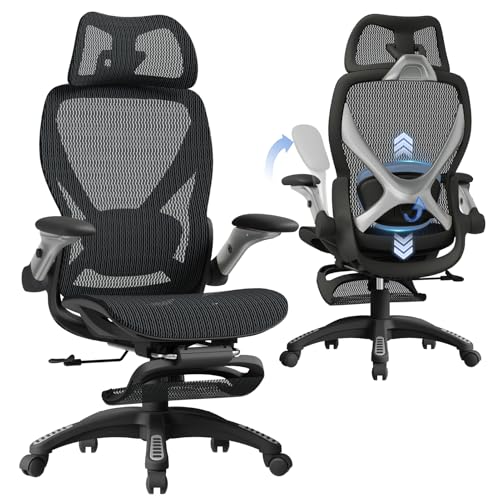 ELABEST X100 Ergonomic Mesh Office Chair |
8.3/10 | Buy |
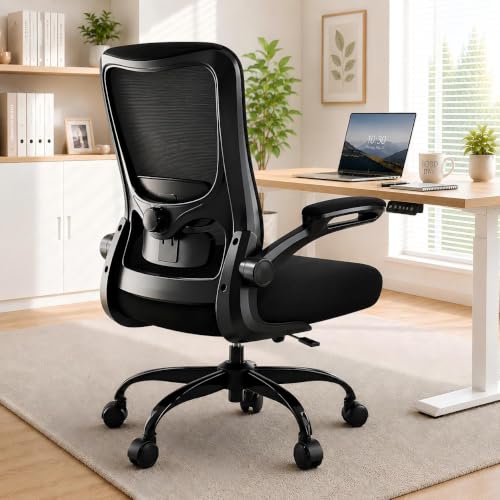 Ergonomic Office Chair for Lower Back Relief |
8.0/10 | Buy | |
 GABRYLLY Ergonomic Office Chair |
8.0/10 | Buy |
The Anatomy and Mechanics of True Ergonomic Seating
Defining what makes an ergonomic chair requires examining how mechanical adjustability interacts with human anatomy. An authentic ergonomic task chair is not simply a plush seat, but rather a dynamic tool engineered to support neutral posture across shifting work routines. By providing targeted adjustments at every major contact point, these chairs reduce localized pressure spikes across the spine, pelvis, and extremities. Several fundamental mechanical and biomechanical elements separate true ergonomic seating from ordinary office furniture.
Biomechanical Principles: Preserving Natural Spinal Alignment
The human spine naturally maintains a gentle S-shape, composed of the cervical, thoracic, and lumbar curves. Prolonged sitting without dedicated support tends to tilt the pelvis backward, flattening the inward curve of the lower back into an unnatural C-shape. This slouched sacral posture dramatically increases intradiscal pressure on the lower spinal discs, which can lead to chronic stiffness and sciatic nerve irritation. An ergonomic chair counters this compression by stabilizing the pelvis and actively reinforcing the lumbar curve throughout shifting postures.
Maintaining an open torso-to-thigh angle between 90 and 105 degrees promotes healthy abdominal circulation and allows the diaphragm to expand fully. When a chair holds your body in an overly restricted upright angle, hip flexors tighten and fatigue accumulates rapidly along the lumbar musculature. Effective seating solutions encourage dynamic micro-movements, allowing the spine to decompress periodically without losing baseline sacral stability. By honoring natural anatomical geometry, ergonomic design minimizes the muscular effort required to stay upright during long working shifts.
Lumbar Support Mechanics: Independent Height, Depth, and Dynamic Tracking
The lower back requires precise reinforcement, making adjustable lumbar support one of the most critical components of any ergonomic task chair. Fixed lumbar contours rarely fit diverse users, as the precise location of the lumbar vertebrae varies significantly based on torso length. Capable seating designs incorporate multi-dimensional adjustments, allowing users to fine-tune both vertical height and horizontal depth. For example, chairs like the Marsail ergonomic desk chair provide explicit depth adjustment of 1.18 inches and vertical travel of 2.16 inches to pinpoint the user’s specific lordotic apex.
Advanced task chairs frequently utilize spring-loaded or auto-tracking lumbar modules that respond dynamically to bodily shifts. Systems such as the dynamic 3D lumbar support found on the ELABEST X100 integrate depth springs and rotational flex to maintain contact as you lean or reach across your desk. When the lumbar pad follows your spinal movement, it prevents the gap that typically forms between the backrest and the lower spine during active typing tasks. This continuous contact distributes upper body weight into the backrest rather than concentrating shear stress across vulnerable spinal joints.
Seat Pan Geometry: Depth Clearance, Width, and the Waterfall Front Edge
The design of the seat pan governs lower-body circulation, pelvic stability, and thigh comfort. A seat pan that is too deep forces the user to sit forward on the cushion, completely disengaging the backrest and lumbar support. Conversely, an oversized seat can press directly against the popliteal space behind the knees, restricting blood flow and causing tingling in the lower legs. An ergonomic seat pan should always preserve a clearance gap of two to three fingers between the front edge of the seat and the back of your knees.
A sloping waterfall front edge is another essential feature that prevents femoral nerve compression by curving downward at the front boundary. This curved shape redistributes contact pressure away from the back of the thighs and toward the pelvic sit bones. Generous seat dimensions, such as the 19.8-inch width on the MOLENTS task chair or the roomy frame of the COMHOMA heavy-duty model, prevent restrictive hip pinching. When your thighs rest comfortably across the cushion without popliteal contact, your pelvis settles naturally against the backrest to maintain neutral posture.
Recline Kinematics: Synchro-Tilt Mechanics and Tension Resistance
Static sitting places continuous static loads on the musculoskeletal system, which makes dynamic recline kinematics a defining characteristic of high-performance task chairs. Basic office chairs often use simple center-tilt mechanisms that pivot the backrest and seat pan together in a fixed 1:1 ratio, which tilts the knees upward and lifts feet off the floor. In contrast, superior ergonomic chairs implement synchro-tilt mechanisms that recline the backrest at approximately double the rate of the seat pan. This synchronized motion opens the torso-to-thigh angle while keeping your feet securely planted flat on the floor.
Multi-position tilt lock controls allow workers to switch smoothly between focused typing postures and relaxed reading positions. Many capable task chairs, such as the CLOUVOU model with its 135-degree recline range and the GABRYLLY chair with a 90 to 120-degree recline window, offer preset stop positions. Adjustable tilt tension controls the mechanical resistance you feel as you push backward against the backrest. Calibrating the tilt tension to match your body weight allows the backrest to act as a responsive counterbalance that mirrors your upper body movements without abrupt shifting.
Armrest Articulation: Reducing Trapezius and Shoulder Impingement
The arms account for a substantial percentage of total upper-body weight, and unsupported arms place continuous isometric tension on the trapezius and neck muscles. High-quality ergonomic chairs feature multi-directional armrests that adjust in height, width, depth, and pivot angles, often referred to as 3D, 4D, or 5D systems. The primary ergonomic goal of armrest adjustment is to support the forearms with the elbows bent comfortably at an approximate 90 to 100-degree angle. This neutral alignment keeps the shoulders relaxed and prevents elevation that can cause chronic upper back stiffness.
Chairs equipped with 3D or 5D flip-up arms, such as the ELABEST X100 or the QLTPLUS model, provide exceptional adaptability for varying workspace tasks. The inward and outward pivot adjustments allow forearms to remain supported while typing on a compact keyboard or writing by hand. Flip-up armrest functionality also lets users raise the arm pads entirely out of the way when playing instruments or sliding the chair beneath shallow desk frames. Padded polyurethane caps protect the sensitive ulnar nerve at the elbow, ensuring armrests serve as genuine ergonomic assets throughout the day.
Cushioning and Upholstery: Molded Cold-Cure Foam vs. Breathable Mesh
The material composition of the seat cushion determines how effectively an ergonomic chair distributes contact pressure across the pelvic floor. High-density molded foam cushions, such as the 3.14-inch foam seat on the Marsail chair or the 4-inch contoured cushion on the QLTPLUS chair, provide durable resilience that resists bottoming out over long working sessions. Molded foam cushions are engineered to distribute body weight across a broad surface area, relieving localized stress on the sit bones. For specialized coccyx relief, adding an ergonomic accessory like the BlissTrends memory foam seat cushion can supply targeted contouring and pressure distribution on standard flat seating surfaces.
Breathable mesh seating has become immensely popular due to its unmatched thermal regulation and elastic contouring properties. Chairs utilizing high-tensile elastomeric mesh, such as the GABRYLLY task chair or the ELABEST X100, facilitate continuous air circulation that prevents heat and humidity buildup during warm working days. The mesh suspension conforms responsively to individual body shapes, reducing pressure hotspots without accumulating moisture. Hybrid designs that combine a breathable mesh backrest with a dense molded foam seat pan offer a balanced solution favored by many remote professionals seeking both ventilation and plush support.
Structural Foundations: Pneumatic Gas Cylinders, Bases, and BIFMA Standards
A chair can feature extensive adjustments, but its long-term reliability depends entirely on the strength of its structural foundation. The core of every height-adjustable task chair is its pneumatic gas lift cylinder, which utilizes pressurized nitrogen to sustain body weight and enable smooth vertical travel. Heavy-duty seating designs typically employ Class 4 pneumatic cylinders and SGS-certified components to ensure leak-free performance over years of daily cycling. These reinforced gas cylinders prevent the frustrating sinking failure common to lower-grade office seating when subjected to continuous daily loading.
The five-star base and caster assembly provide the stability and rolling mobility necessary for safe desk navigation. Quality task chairs feature reinforced nylon or solid metal bases tested against rigorous industry benchmarks such as ANSI/BIFMA X5.1. BIFMA certification verifies that the frame, base legs, and tilt mechanisms have endured rigorous impact testing to withstand real-world workplace stresses. Weight capacities ranging from 250 pounds on compact models like the BestOffice chair up to 330 or 350 pounds on models from Marsail, Zeonsit, and QLTPLUS reflect robust internal engineering.
Anthropometric Fit: Sizing Chairs for Petite, Standard, and Tall Frames
Ergonomics is fundamentally rooted in anthropometry, the scientific measurement of the human body and its proportions. A chair cannot be genuinely ergonomic if its physical dimensions fail to accommodate the user’s specific stature. For instance, the GABRYLLY mesh chair specifies an optimal user envelope between 5’2″ and 6’1″, while the CLOUVOU chair includes backrest scaling built to accommodate taller individuals up to 6’5″. Checking the vertical stroke range of the gas lift cylinder ensures your feet can rest flat on the floor with your knees bent at 90 degrees.
Petite desk workers often face unique ergonomic hurdles, such as seat pans that are excessively deep or cylinder heights that leave feet dangling without floor support. Dangling legs pull the pelvis forward and strain the lumbar spine, making an adjustable footrest or a low-profile gas lift essential. Examining dedicated workstation setups for shorter desk workers illustrates how coordinating chair height with desktop surfaces eliminates postural compensation. Conversely, taller professionals require higher backrests and extended seat depths to prevent thoracic rounding and provide adequate thigh support.
Integrating active movement routines alongside your ergonomic chair provides the most effective defense against sedentary fatigue. Many professionals maximize their comfort by pairing an ergonomic chair with a standing desk, alternating between sitting and standing throughout the workday. An adjustable headrest, like the 2D and 3D headrests found on models from Marsail and GABRYLLY, offers critical suboccipital support during reclined resting phases. Sizing every component to your physical profile ensures your workstation supports your health rather than compromising it.
Systematic Calibration: Fine-Tuning Your Chair for Daily Ergonomic Harmony
Owning an adjustable chair is only half the battle; knowing how to calibrate each feature systematically establishes lasting comfort. Begin by setting the pneumatic seat height so that your feet rest firmly flat on the floor with your thighs parallel to the ground. Next, slide your hips fully against the rear backrest and verify that you have two to three fingers of space behind your knees. Once the lower body is settled, slide the lumbar support cushion into the natural curve of your lower back to stabilize your lordotic arch.
Adjust your armrest height and width so your forearms rest comfortably level with your desk surface, keeping your wrists neutral as you type. Set your tilt tension knob so the backrest yields smoothly to gentle reclining pressure without collapsing under your body weight. If your chair includes an adjustable headrest, align the cushion with the base of your skull rather than your upper neck to support natural cervical curvature. Taking ten minutes to methodically tune these contact points transforms a collection of mechanical parts into a personalized posture support system.
Revisiting your chair settings periodically helps you maintain ideal alignment as work habits, footwear, and desk accessories evolve. Listen to subtle physical cues like shoulder tension, hip numbness, or lower back stiffness, which often indicate that a specific adjustment has slipped out of alignment. An authentic ergonomic chair provides the mechanical freedom to adjust to your body, promoting dynamic movement, healthy blood flow, and sustained workday energy. Prioritizing thoughtful adjustability, certified structural durability, and proper anthropometric fit ensures your workstation actively protects your long-term spinal well-being.
About the author
Kaitlyn Wells is an experienced product journalist covering home office equipment, productivity, and technology. With more than a decade of experience working from home in various capacities, she understands the importance of creating comfortable and functional workspaces. Her reporting on office chairs and workplace equipment combines product research with practical considerations, helping consumers understand how furniture features, comfort, and individual needs influence purchasing decisions.