
Should I Get a Sit Stand Desk? Practical Workstation Guide for 2026
Deciding should i get a sit stand desk? Explore ergonomic benefits, converter options, and posture setups for October 2026 to build a healthier workspace.
 By Camryn Rabideau
Updated October 9, 2026
By Camryn Rabideau
Updated October 9, 2026

Prolonged static sitting often leads to mid-day lower back tightness, hunched shoulders, and sluggish physical energy levels. Many knowledge workers question whether an active workstation can solve these persistent aches, asking themselves should i get a sit stand desk to improve their daily comfort and productivity. Transitioning between sitting and standing encourages gentle muscle engagement, relieves lumbar spine pressure, and promotes natural spinal alignment. Understanding standing desk workstation guide fundamentals helps clarify whether an adjustable frame or a tabletop riser fits your physical routine.
Selecting an adjustable setup depends on your daily workflow, physical height requirements, and existing office furniture. Exploring home office desk selection reveals that you do not always need a complete furniture overhaul to gain ergonomic flexibility. Compact desktop risers and motorized platforms allow you to alternate postures without abandoning your current workspace layout. Examining your equipment weight, monitor configurations, and available tabletop depth makes it easier to determine if a dynamic sit-stand solution meets your personal needs.
| Award | Product | HOF Score About HOF ScoreThe HOF Score is our own rating from 0 to 10, based on performance, design and build, ease of use, and value. It reflects independent research and is never influenced by manufacturers, retailers, or affiliate commissions. Learn more › | |
|---|---|---|---|
| Best Overall |
 VIVO Black 26 in Single Top Standing Desk
|
8.6/10 | Buy |
| Best Value |
 VIVO Light Wood 26 in Single Top Standing Desk
|
8.3/10 | Buy |
| Best Budget |
 VIVO Black 28 in Standing Desk Converter
|
8.1/10 | Buy |
| Best Premium |
 Mount-It! Standing Desk Converter 32" x 22"
|
8.1/10 | Buy |
 VIVO Black 32 in Single Top Standing Desk
|
7.8/10 | Buy | |
 VIVO Black 32 inch Standing Desk Riser, DESK-V000S
|
7.8/10 | Buy |
Evaluating the Value and Practical Realities of Sit-Stand Workstations
Deciding whether to add an active height-adjustable workstation to your routine requires balancing personal comfort with workspace constraints. Sitting continuously for eight to ten hours places sustained pressure on spinal discs and restricts blood circulation in the legs. Regular standing intervals relieve muscular tension, but standing all day creates separate postural fatigue issues. A versatile sit-stand setup provides the flexibility to alternate postures whenever fatigue begins settling into your lower back or neck.
Biomechanical Impact: How Alternating Postures Affects Spinal Compression and Fatigue
Static postures create sustained muscular loading that exhausts stabilizing muscles over time. When you remain seated in an office chair, your pelvis rotates backward, flattening the natural curve of the lumbar spine. This postural slump increases intervertebral disc pressure and tightens hip flexors, pulling uncomfortably on the back when standing up. Alternating between sitting and standing redistributes mechanical loads across your musculoskeletal system, allowing fatigued tissues to recover naturally.
Standing periodically also promotes venous blood return from your lower legs back to the heart. Sedentary routines slow venous return, causing fluid pooling in the feet and noticeable mental sluggishness by mid-afternoon. Light muscular engagement from maintaining an upright balance encourages circulation without requiring strenuous physical effort. Shifting your weight between feet or stepping on a cushioned surface further minimizes joint stiffness while keeping you alert during work sessions.
Excessive static standing without movement can trigger sore arches, stiff knees, and tired lumbar extensors. The primary benefit of an adjustable desk lies in postural variety rather than continuous standing. Switching positions every thirty to forty-five minutes prevents the negative effects of both prolonged sitting and prolonged standing. Listening to early fatigue cues in your lower back helps you establish an intuitive cadence that keeps your body energized throughout the day.
Full Sit-Stand Desks Versus Desktop Converters: Choosing the Right Workstation Architecture
Many buyers wonder whether they must replace their entire desk or simply add a desktop converter to their current surface. Full motorized desks provide expansive continuous tabletop space, broad height adjustment ranges, and under-desk wire management. However, complete desk replacements require disassembling existing furniture, managing substantial room space, and investing in dedicated lifting frames. If you already own a sturdy desk, an ergonomic riser lets you test an active standing workflow without discarding functional furniture.
Desktop converters sit directly on top of your existing workstation surface and raise screens and input devices upward. Units like the VIVO Black 26 in Single Top Standing Desk Converter provide an immediate transition into active standing without requiring assembly. These compact platforms preserve surrounding desk real estate for notebooks and paperwork while lifting your primary screen to eye level. For remote workers in rented apartments or shared corporate offices, desktop risers deliver sit-stand functionality with zero structural modifications.
Budget considerations and available space often dictate which workstation style makes the most practical sense. If you are comparing dedicated motorized options, reviewing budget electric standing desks helps illustrate the dimensions and space requirements of complete frames. On the other hand, tabletop risers offer an accessible entry point that delivers immediate postural relief on a modest footprint. Deciding between a full furniture frame and a desktop converter depends largely on how much surface area your daily tasks demand.
Lifting Mechanics and Weight Capacities: Gas Spring Struts Versus Mechanical Notches
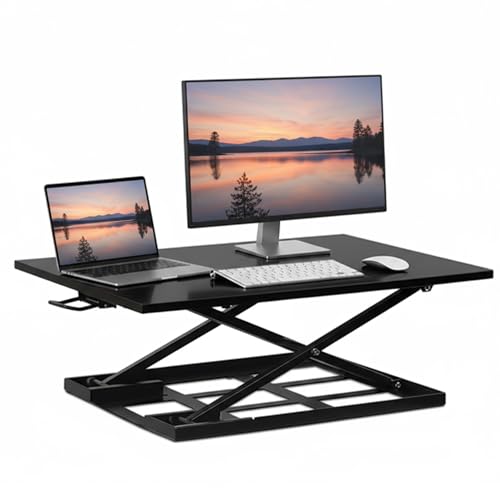
The adjustment mechanism inside a sit-stand unit directly determines how smoothly and safely you can change working heights. Desktop converters generally utilize either pneumatic gas spring struts or mechanical stepped locking pins to secure the platform. Pneumatic gas springs provide counterbalanced lift assistance, absorbing the weight of your computer equipment as you pull the release handle. Models such as the Mount-It! Standing Desk Converter 32″ x 22″ use smooth gas springs to raise hardware smoothly from a low 2.5-inch resting height up to 16.9 inches.
Mechanical locking risers rely on notched steel channels that secure the platform into designated elevation stops. The VIVO Light Wood 26 in Single Top Standing Desk Converter features five distinct lockable height settings ranging from 8.5 inches up to 15.9 inches above the table surface. Stepped settings offer rigid mechanical support at predefined intervals, ensuring that the platform remains locked during heavy typing. However, continuous pneumatic systems allow you to fine-tune elevation to any point within their travel range rather than restricting you to fixed notches.
Dynamic payload limits require careful consideration before mounting heavy computer accessories or dual display setups. Single-surface compact risers typically support up to 17.6 pounds of hardware on their upper deck. In contrast, heavier-duty pneumatic units like the VIVO Black 28 in Standing Desk Converter support up to 28.6 pounds across their reinforced steel chassis. Overloading a pneumatic lift reduces its counterbalanced assist, forcing you to exert physical effort to pull the platform upward.
Ergonomic Geometry: Calculating Seated and Standing Heights for Proper Alignment
Achieving proper ergonomic alignment requires positioning your keyboard and screen so your joints rest in neutral postures. When typing, your upper arms should hang naturally beside your torso with forearms resting parallel to the floor at an approximate 90-degree to 100-degree elbow bend. Your wrists must remain straight rather than flexing upward or downward against the work surface. Positioning input devices too high causes your shoulders to shrug upward, creating painful trapezius tightness and chronic neck stiffness.
Screen height dictates cervical spine posture and head tilt while reading documents or viewing video streams. The top third of your display glass should sit directly at or slightly below eye level when you look straight ahead. This downward viewing angle of roughly 15 to 20 degrees encourages a natural head posture that avoids compressing cervical vertebrae. Desktop converters naturally elevate your monitor above the keyboard plane, helping you prevent forward head slouch without requiring separate monitor stands.
Resting profile height plays a critical role when working in a seated position on top of an existing desk. Adding a converter to a standard 29-inch desk raises your resting keyboard height by anywhere from 1.8 inches to nearly 5 inches. Ultra-slim converters like the VIVO Black 32 in Single Top Standing Desk collapse down to 1.8 inches, minimizing the seated elevation boost. If a converter sits too tall while lowered, you may need to raise your office chair and use an ergonomic footrest to maintain neutral knee and elbow angles.
Surface Real Estate and Multi-Monitor Support: Single-Tier Platforms Versus Tiered Trays
Workstation layout determines whether a single continuous surface or a split-level tiered design suits your peripheral gear. Single-tier converters offer one continuous flat deck where you place your laptop, secondary screen, and external peripherals together. Platforms measuring 31.5 inches by 18.5 inches provide ample room for a laptop and a compact external display alongside a low-profile keyboard. These single decks work well for laptop-centric workers who prefer keeping writing pads, mice, and mobile phones on one unified level.
Tiered converters separate the viewing platform from the typing platform, placing the keyboard and mouse on a lowered tray. Models like the VIVO Black 32 inch Standing Desk Riser feature a 31.5-inch upper deck for dual screens while suspending a lower tray for typing. This physical separation creates an ergonomic height differential between your hands and your display panels. Lowering the keyboard relative to the screen allows taller users to achieve eye-level screen height without forcing forearms into an uncomfortably high typing position.
Evaluating your display mounting preferences helps determine which tray architecture will handle your workstation peripherals best. Heavy dual-monitor arms require sturdy desktop clamping areas and enough depth clearance to prevent tipping hazards. Placing heavy freestanding monitor bases on an upper tier consumes substantial depth, leaving less room for documents or webcams. Verifying the weight of your monitors and stands against the riser payload rating prevents frame bowing and ensures effortless lifting motion throughout the day.
Workstation Stability: Mitigating Typing Bounce and Monitor Sway at Elevated Heights
Workstation stability directly impacts your concentration and typing accuracy when elevating gear to standing height. A standing platform that wobbles or flexes under moderate palm pressure causes distracting monitor shake with every keystroke. Vertical scissor frames and straight-lift columns differ in how they manage lateral and front-to-back mechanical forces. Units engineered with heavy-gauge steel supports and wide base footprints absorb typing resonance effectively, keeping display screens steady during rapid input tasks.
Vertical lift paths preserve your desk surface footprint while maintaining a stable center of gravity directly over the base. Some converter designs extend forward in an outward arc as they rise, pulling heavy equipment toward the user. This forward motion shifts hardware weight away from the support base, increasing tipping risks and crowding your physical standing space. Converters with straight vertical elevation, such as the Mount-It! 32″ x 22″ model, raise gear straight up and down, preserving balanced weight distribution at full extension.
Checking the sturdiness of your underlying base desk is equally important for preventing excessive screen vibration. Even a heavy-duty converter will wobble if placed on an unlevel, flimsy card table or lightweight hollow-core particleboard desk. Placing the converter centrally on a rigid, solid wood or heavy composite desk ensures solid structural grounding. Exploring easy desk assembly solutions can help you evaluate baseline desk foundations that provide rigid stability under dynamic converter loads.
Establishing Sustainable Sit-Stand Routines: Moving Beyond Static Postures
Acquiring an adjustable desk setup is only the first step toward building an active, healthy working environment. Many people enthusiastically stand for several hours during their first week, only to suffer sore heels and lumbar exhaustion. The key to long-term success lies in building a gradual habit that introduces posture shifts in moderate intervals. Adopting a structured approach like the 20-8-2 routine, sitting for twenty minutes, standing for eight minutes, and moving for two minutes, creates sustainable daily variety.
Footwear choices and floor surfaces significantly influence how comfortable you feel while working on your feet. Standing on bare hardwood, ceramic tile, or thin commercial carpeting compresses the fat pads in your heels and strains plantar fascia tissues. Using a supportive anti-fatigue mat cushions joint impact, encourages subtle calf muscle contractions, and reduces lower back pressure. Wearing supportive indoor shoes with cushioned arches rather than working barefoot or in flat slippers further protects your knees and hips.
Scheduling specific calendar reminders or timer prompts can assist in establishing automatic posture transition habits during busy workdays. When you become deeply engaged in writing code or drafting reports, you easily lose track of static time. Setting a silent phone alarm or using desktop notification tools nudges you to squeeze the lift handle and change your working stance. Over several weeks, shifting your workstation height becomes an effortless physical reflex that prevents stiffness before it starts.
Making the Decision: Workstation Space, Equipment Load, and Daily Habits
Answering whether an adjustable sit-stand unit is right for your office setup comes down to evaluating your physical comfort, gear load, and room constraints. If you experience persistent lumbar ache, tight hamstrings, or mid-day sluggishness from prolonged sitting, dynamic posture changes offer tangible physical relief. If your daily work relies on a laptop or a single monitor setup, a preassembled converter like the VIVO Black 26 in riser delivers instant ergonomic utility with zero assembly headaches.
Conversely, professionals managing complex triple-monitor arrays, heavy desktop audio interfaces, or extensive paper files might find compact desktop risers somewhat restrictive. Heavy studio setups often exceed the 17.6 to 28.6-pound payload boundaries of compact converters, making a dedicated heavy-duty motorized frame a better long-term choice. Taking accurate measurements of your existing tabletop depth, weighing your hardware, and assessing your available clearance ensures that you select an appropriately sized solution.
Investing in a sit-stand solution provides a proven pathway to reducing sedentary fatigue and promoting dynamic movement throughout your workday. Whether you choose a compact mechanical converter for your existing furniture or plan for a motorized standing workstation, prioritizing posture variety transforms your daily comfort. Take time to assess your equipment payload, verify your seated and standing height clearances, and establish a gradual transition routine that supports your long-term physical wellbeing.
About the author
Camryn Rabideau is a freelance writer and product reviewer with a background in product design and journalism. Since becoming a full-time freelance writer in 2016, she has developed extensive experience researching and testing consumer products for the home. Her work focuses on practical product performance, usability, and purchasing considerations. Her combination of product design knowledge and hands-on testing experience provides a useful perspective on furniture, household products, and everyday living.